Friday Book Whimsy: The Broken Girls

Simone St. James is the author of a series of books, all ghost stories. Ghost stories have never been my cup of tea, but The Broken Girls intrigued me. I decided to turn on the lights to keep the ghosts at bay and give the book a try.

It’s been 20 years since Fiona Sheridan’s sister Deb was found dead on the grounds of a boarding school called Idlewild in a small Vermont town.  Despite the fact that a man was arrested and has been imprisoned for the murder, Fiona hasn’t come to grips with her sister’s death. Something doesn’t seem right. Now, as part of her job as a journalist, she learns that the school—long closed and reportedly haunted—is about to be rehabilitated and reopened.

What Fiona doesn’t know is that 20 years before her sister was killed, another girl went missing from Idlewild, which at that time was a boarding school for throw-away girls: illegitimate, unloved, without parents. So when a body is dug up during the reconstruction, Fiona throws herself into learning the secrets of Idlewild and the truth about her sister’s death.

Part mystery, part thriller, part ghost story, I couldn’t stop reading this book. I’m generally not fond of ghost stories, generally finding them somewhat silly, but Mary Hand—the unsettled ghost who can’t find rest at Idlewild—seemed to enhance the story rather than distract. I found all of the female characters to be strong and interesting. I especially loved the four roommates who kept each other strong in the 1950 story line.

The ending was delivered with a twist, and was quite satisfying. All in all, I enjoyed The Broken Girls very much.

Here is a link to the book.

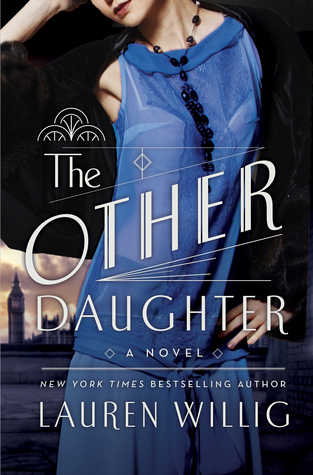
Friday Book Whimsy: The Other Daughter

Author Lauren Willig is perhaps best known for her Pink Carnation series, of which I’ve read exactly none. But given that I’ve liked her writing in other stand-alone books, I decided to give The Other Daughter a try.

Rachel Woodly has been tutored, loved, and taught genteel manners by her hard-working mother after her father doesn’t return from a trip. Rachel was told that he died, and because he died so far away (and it was the 1920s), he was buried where he passed away.

She takes a job as a governess for a wealthy society family. She is traveling with the family in France when her mother takes ill. Rachel doesn’t receive word of her mother’s illness until it’s too late. By time she gets home, her mother has passed away.

While cleaning up her mother’s house, she comes across a newspaper clipping that shows a recent photo of her father – not dead, but instead, quite alive, and an Earl with an entire separate family. Rachel is unable to come to grips with this shocking information, and decides to pass herself off as a society woman with the help of a wealthy acquaintance in order to confront her father.

Her plan works, but she unexpectedly grows to like the woman who is her half-sister. Drama ensues as Rachel learns the truth about what happened between her mother and father, and why he has a whole new life. The story is quite compelling.

Willig is a very good writer, and her story kept me turning pages. The Other Daughter is one of her few attempts at writing a novel with a single perspective instead of the back-and-forth-in-time perspectives that have become so popular. I think that was one of the things I liked best about this book.

I enthusiastically recommend The Other Daughter.

Here is a link to the book.

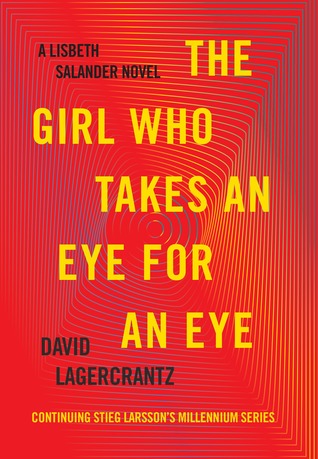
Friday Book Whimsy: The Girl Who Takes an Eye For An Eye

Lisbeth Salander is not for everyone, and The Girl Who Takes an Eye for an Eye, the fifth in the so-called Millennium Series that started with The Girl With the Dragon Tattoo, won’t be a book that everyone would want to read.

The original author, Stieg Larsson, passed away a few years ago, and the series was taken over fairly seamlessly by an author named David Lagercrantz, who has managed to keep the flavor of the books. Both the original author and the new author are Swedish, and I find that the translations make the writing style very unique.

The main character, Lisbeth Salander, is also unique in that she is strong, brilliant, absolutely without emotion, and yet fights strongly for herself and anyone else she believes is being treated unfairly. In The Girl Who Takes an Eye for an Eye, Lisbeth manages to save a young Islamic woman who is in prison with her from the woman’s evil brothers, and fights off a prison gang leader who has Lisbeth in her sights. She, along with one of the very few people she trusts – journalist Mikael Blompkvist – work together to  uncover a secret plan from years ago in which parents of twins were unwillingly required to separate their children for scientific research.

The books are brutal in nature, and usually have quite vivid sex scenes, though this one didn’t. I will admit that they are not my favorite mysteries, but there is something very compelling about the main character and the paths she follows that make me continue to enjoy the series.

If you have read the rest of the series, you can’t stop now!

Here is a link to the book.

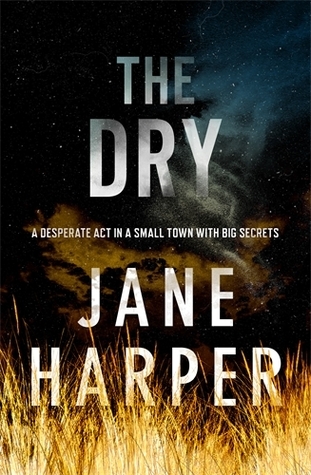
Friday Book Whimsy: The Dry

The Dry, by Jane Harper, takes place in a small town in Australia, the kind of small town where everybody knows everyone else’s family and has their nose into who’s doing what. It’s from that small town that Australian Federal Agent Aaron Falk escapes after one of his friends is found dead decades before, and he was a suspect in her murder. Now, his childhood BFF Luke – who provided Aaron’s with an alibi that kept him from being arrested – has died from an apparent self-inflicted gunshot wound, after killing his wife and his young son.

So, after all this time, Falk returns home for the funeral, and to try and come to grips with how this friend could have possibly done something so uncharacteristic, so against his nature. Well, it turns out that Luke’s parents also don’t believe it, and they convince Falk – who isn’t a homicide investigator, but instead conducts financial investigations – to, well, investigate.

But here’s the thing: Falk knows that the alibi that Luke provided years ago was a lie; however, he also knows that he was innocent of the crime. Could the two murders be connected in some way? He reluctantly agrees to spend a few days looking into the deaths.

The author doles out the secrets of both crimes little by little, leaving the reader to suspect different people throughout the book. The plot is set against the worst drought in a century. The writing is so good that you can practically fill the heat and hear the crunch of the grass as the characters walk through the plot.

I found the solution unpredictable almost to the end of the book, though I will admit to figuring it out just a bit before the detective.

The Dry is the first in a series, and her second book – Force of Nature — was released this past February. I’m eager to see if it’s as good as The Dry.

Here is a link to the book.

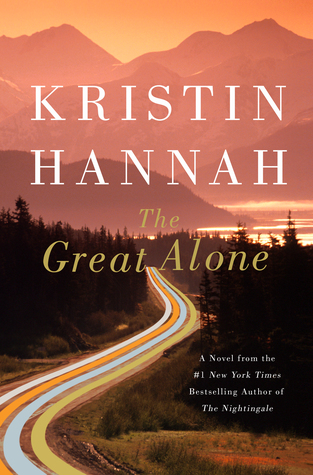
Friday Book Whimsy: The Great Alone

If an author has done his or her job right, there’s something in their novel that drives the story. Something that makes people continue to turn the page. Something that the reader thinks about long after they’ve closed the book.

In The Great Alone, the latest offering from Kristin Hannah (who has written such bestsellers as The Nightingale and Firefly Lane) the “something” is Alaska. Even when Hannah’s latest storyline was so depressing that I wasn’t always sure if I wanted to continue, the Alaskan wilderness kept calling me back.

It’s 1974, and Ernt Allbright returns home from Vietnam after living in a POW camp for a few years. His wife Cora, the daughter of wealthy parents who married Ernt against their will, recognizes immediately that he is a changed man. The man with whom she fell in love and for whom she defied her parents is now sullen,unstable, and dangerously volatile. Their 13-year-old daughter Leni, can’t remember the father who wasn’t so unpredictable.

Feeling the need for a change, Ernt moves his family to a remote area of Alaska, where he hopes to homestead and live off the land. Cora agrees, optimistic that a change is necessary to save the family. It works for a while, but eventually Ernt’s mental instability takes over and things take a nosedive.

The Great Alone is a story of neediness, friendship, and dysfunctional love. It is taut with tension and anger. The incredibly difficult living conditions in this small Alaskan town create a dependence on each other that can benefit or wreck someone as emotionally fragile as Ernt Allbright.

I’ve never been to Alaska. I don’t know if a small town in remote Alaska today would look like it did in this book. While the story is unendingly depressing –ironically, nearly laughingly so – I found myself continuing to turn the pages because I was intrigued by the notion of living in such a wilderness. People relied on one another because, particularly during the winter, there were no others on whom to rely. It’s an intriguing background story for a novel.

I find Hannah’s novels to be somewhat predictable and her characters fairly one dimensional; nevertheless, I will give The Great Alone a weak huzzah for its important topic and setting. If you like Hannah’s other novels, you are likely to enjoy this one as well.

Here is a link to the book.


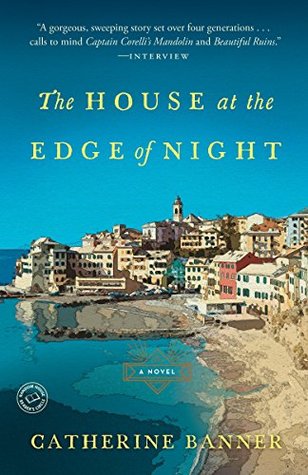
Friday Book Whimsy: House at the Edge of Night

My husband and I were lucky enough to spend three months in Europe a few years back. Nearly two of those three months were in Italy. While I don’t have a drop of Italian blood in me, I’m convinced I lived in Italy in a former life! From the time I first stepped foot into the country, I fell in love with the people, the climate, the food, the art, and the culture.

Reading The House at the Edge of Night, by Catherine Banner, was a bit like sitting at a table all day on a piazza in an Italian hill town watching the villagers live their lives. The author managed to successfully capture the flavor of the people of this wonderful country nearly perfectly.

The House at the Edge of Night is a multigenerational saga of a family who lives on the fictional island of Castellamare in southern Italy near Sicily. Amedeo Esposito is an orphan who is taken under the wing of a doctor in Florence. He takes his last name and follows his lead in the medical field. He winds up on Castellamare, where the native people eye him suspiciously – as Italians are wont to do. Eventually he marries his beautiful wife named Pina who is strong-willed and smart as can be. Though it takes a bit, the locals eventually accept him as one of their own.

Unfortunately, Amedeo makes a big mistake that results in two babies being born on the same night – one to his wife and one to the wife of the nasty Count who lives on the island. The Countess claims Amedeo is the baby’s father, and unfortunately, it could be true.

The story goes on from here, as Pino agrees to continue to live with him and raise their family. This leads to that, and Amedeo finally gives up his medical practice to open a café in his home, which is referred to as the house at the edge of night. This café takes on a life of its own, and as the years go by, the café itself is as much a character as the people who walk and talk.

Readers watch the wonderful characters that inhabit the island as they live through world wars, attempts to steal relics, an economic downturn that nearly cripples the population, love affairs, births and deaths. At the end of the day, however, it always comes back to the house at the edge of night.

I loved the story. I found its casual pace to be much like the casual pace of life in Italy. As the author described the food, and particularly the homemade limoncello and limettacello and arangcello that they drank morning, noon, and night, I could taste it. I could feel the hot sun on me as she described the town. I think she really captured the flavor of Italy.

It made me want to make sure my passport was updated!

Here is a link to the book.

Friday Book Whimsy: Our Year at War: Two Brothers, Vietnam, and a Nation Divided

I graduated from high school in May 1972. By that time, the Vietnam conflict was winding down. In fact, the draft ended in January 1973. The timing was such that I wasn’t directly impacted by the war. I remember seeing images every night on television – both images of the war and images of the protests. But I was not personally acquainted with anyone who was drafted into the military or went to Vietnam as a soldier.

The impact of the Vietnam War was much different for my sister who is five years older than I. She knew people who were drafted. She knew people who went to Vietnam. My only experience was hearing my friends talk about the draft lottery number of their brothers or cousins or acquaintances. Nevertheless, I remember it was a scary time.

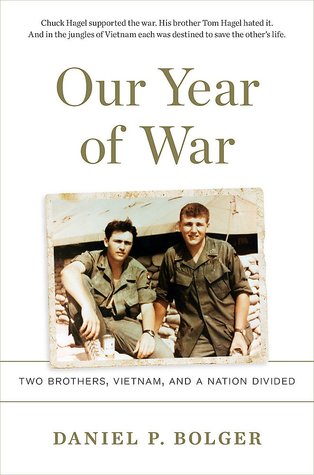
Our Year at War: Two Brothers, Vietnam, and a Nation Divided, by Daniel Bolger, is the true story of two brothers from a small town in Nebraska who fought the war side-by-side, surviving, but leaving Vietnam with two different opinions. I’m not normally a reader of nonfiction, and a book about war would certainly not be of any interest to me. However, the two brothers featured in Bolger’s book – Chuck and Tom Hagel — happened to be from the town where I spent the first 18 years of my life. In fact, both of the boys attended the same small Catholic high school as I, though several years before me. Tom Hagel went to school with my sister.

This six degrees of separation caused me to read the fascinating – if horrifying – account of one of the most difficult times in U.S. history. Not only are the stories about the two young men from my home town interesting, but the details about the war itself are riveting. Since the war was still going on, I didn’t study it in school. Film depictions of the war are mostly one-sided and extremely troubling. Bolger provides mostly nonopinionated background as well as very detailed accounts of what brought about the war – which actually started much earlier than I had ever imagined — as well as the battles themselves.

The two brothers received extensive military recognition, including purple hearts and the bronze star. They literally served side-by-side, despite the laws which are supposed to prohibit brothers fighting in the same units. They were both injured, and narrowly escaped death on several occasions. They were courageous and dedicated. They, like all of the military men and women who fought in Vietnam, came home to a divided nation. And they were, themselves, divided.

One of the brothers went on to become a judge; the other went on to become a United States Senator from Nebraska and eventually the Secretary of Defense in the Obama Administration.

I will admit to a fair amount of skimming when it came to some of the details of the war planning. Still, I enjoyed the book very much and strongly recommend it, particularly for anyone interested in this period in US history.

Here is a link to the book.

Friday Book Whimsy: The Ashford Affair

I’m honestly beginning to think that the more prolific female fiction writers are starting to use plot templates that they got from a secret club to which they all belong, and they simply change the names, locales, and the precise situations to fit the template. What else could account for the oh-so-predictable story line of a busy contemporary professional woman running smack dab into the glass ceiling despite working harder than any man, and then finding out about a family secret that changes their life, while meeting the love of her life in the meantime? What follows is the inevitable back and forth between a character from the late 19th or early 20th century to a more contemporary heroine. It is starting to get so tiresome, and authors are starting to seem so lazy.

I’m afraid that my boredom with this plot technique colored my opinion of The Ashford Affair by Lauren Willig. Willig is actually a good writer, so it is a disappointment to see her fall into this same trap. The Ashford Affair’s only saving grace – at least as far as this reader is concerned – is that some of the story takes place in Kenya which made the plot more interesting. The earlier time period is the early 1920s, and I happen to find this period in world history quite interesting.

Clementine Evans has worked her tail off pursuing her dream of making partner in the law firm in which she works in 1999. Unfortunately, her elderly grandmother Addie – who loved Clemmie very much and helped her deal with a disapproving mother – takes a turn for the worse, and is dying. Before she dies, Clemmie becomes aware of a secret that could change everything she knew about her family.

Flashback: Addie’s mother and father are killed when she is 5, and Addie is sent to live with a cold and uncaring aunt and uncle in England. Addie’s only friend is her cousin Bea, who, though only 7, is beautiful and already being groomed to marry well. The two become dear friends until they are grown up and Bea betrays Addie by stealing her boyfriend and marrying him.

Flash forward: When Clemmie’s grandmother dies, she goes to the funeral instead of a meeting she was expected to attend, and is turned down for partnership. Shock. So she and a distant cousin with whom she once had a fling decide to try and solve the mystery of their family’s background.

What follows is a predictable, if well-written, story that was a good enough read to keep me marginally engaged but predictable enough to make me work to try and keep from getting confused with other novels I’ve read.

I can’t unequivocally recommend the book unless you are in the mood for something that won’t require a lot of thinking.

Here is a link to the book.

Friday Book Whimsy: The Woman in the Window

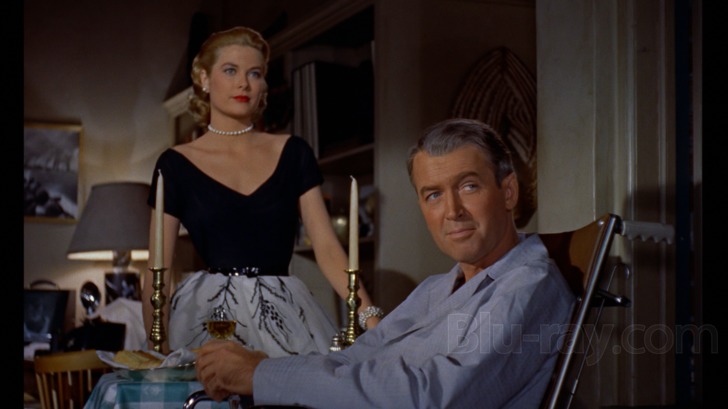
I love Alfred Hitchcock movies, and Rear Window, starring the adorable James Stewart and a stunning Grace Kelly, is one of my favorites. Being one who will “write” a story about someone after just a quick observance, I always loved that he put together – and solved – an entire murder mystery just via what was really just voyeurism. I can overlook the tad bit of creepiness involved.

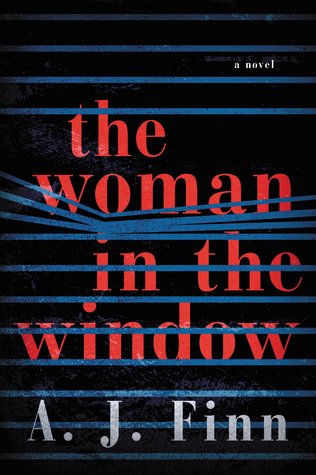
Because of my love of that movie, the plot of the novel which was purported to be the next Girl on a Train or Gone Girl grabbed my attention. The Woman in the Window by A.J. Finn seemed to be right up my alley. From the first pages, the plot grabbed ahold of me and it never let go.

Anna Fox spends her days in her New York City apartment where she has become a victim of her own agoraphobia. When she isn’t watching old movies and drinking way too much wine, she is peering out her windows watching her neighbors. Just like James Stewart in Rear Window, Anna believes she witnesses a murder.

The police don’t believe her; in fact, they think she’s pretty crazy, because it seems the woman she claims she saw murdered never actually existed. The man she believes killed his wife disavows that woman’s existence, and introduces her to his actual wife. Their son seems scared, but supports his dad’s claims. What the hell?

Anna pursues the matter, though fully unable to venture even a few feet out her door. The more she digs, the more the reader learns about Anna herself. The twists and turns in this absolutely gripping thriller are unpredictable and made me shout out loud in dismay. How could I have missed this? The ending, while wholly unpredictable, wasn’t the biggest surprise this reader faced in this clever book.

The Woman in the Window is the author’s debut novel, and it is a mighty good first effort. If you like thrillers or are a fan of Rear Window, grab this book and settle in as soon as possible.

Here is a link to the book.

Friday Book Whimsy: The Third Wife

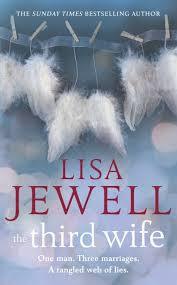
Adrian Wolfe has been married three times. Twice divorced with children from each marriage, he has maintained friendships with all of his wives, and they with each other. The third try, however, doesn’t end on quite as positive a note. His third wife is hit by a bus one night after spending the evening drinking. Did she commit suicide? Was she pushed? And why was she out drinking anyway?

The author of The Third Wife is one of my favorite writers – Lisa Jewell. Her puzzlers are always truly puzzling and her characters are all realistic and flawed, but mostly likeable. This book was no exception. It was interesting to look at Adrian and his big, supposedly happy extended family and imagine that anyone could be so clueless as to think that all of this was as it appeared. It isn’t hard for the reader to put his or herself in Maya’s Third-Wife shoes and realize that it wasn’t all fun and games to be part of this whole scenario.

The author kept me wondering throughout the book. Who was sending Maya such mean emails? Do they all like each other as much as it seems? Did Maya jump or get pushed? I kept thinking that the answer was obvious, and yet again and again it became apparent that things weren’t always what they seemed.

I loved the ending of the book. It felt realistic to me and boded well for the future of the entire Wolfe clan.

Thumbs up on this book.

Here is a link to the book.