
I have discovered over the course of the past couple of years that I am drawn to coming of age stories. Two of my favorite books of 2013 – Tell the Wolves I’m Home by Carol Rifka Brunt and Swimming in the Moon by Pamela Schoenewaldt are both stories of young people coming face-to-face with adulthood and handling it with courage.
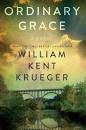
It’s not surprising, then, that I so enjoyed Ordinary Grace, by William Kent Krueger.
I have become familiar recently with Krueger’s writing, but only through his Cork O’Connor mystery series. While there is a murder as part of this book, the whodunit side of the murder dwindles in importance to how people responded and how relationships grew and withered. Ordinary Grace is not a murder mystery.
The story is narrated by Frank Drum, a 13-year-old child of a Methodist minister and his wife, an accomplished musician, who live in a small Minnesota town. He has a younger brother, Jake, and an older sister, Ariel. The format for the narration is Frank’s recollection of the summer when he came face-to-face with death in many forms, looking back at it from four decades later. It was the summer of 1961.
I liked many things about the book.
First, I liked the setting against the 1960s backdrop, when many things were changing for everybody. Having grown up in a smaller community during that time, I could relate to many of the things that took place – the gossip, the freedom the two boys had roaming around the town, the absolute trust in God and in adults. They got haircuts at barber shops. They drank lime phosphates at the drug store. Very typical 60s experiences.
Second, I found the characters in the book to be some of the most memorable I have come across in my reading. I will long remember Frank’s father, Pastor Nathan Drum. He, thankfully, was not the typical literary caricature of the evil Methodist minister. Nathan was kind and gentle, slow to judge, and above all, had total and complete faith in God.
I also won’t forget Gus, the church’s maintenance man, but even more, Nathan’s friend and a person who the boys totally trusted. Throughout the book, a common line was, “What do we do? Talk to Gus.” Gus is a complex character – kind and smart but held back by his drinking. I don’t want to give away too much of the book, but there is a scene in which the boys hear their grieving father, who has had to hold the family together through a period of incredible grief, crying – sobbing out loud – in the church being comforted by Gus. It is one of the most poignant scenes I’ve ever read.
Frank’s little brother Jake, while secondary to Frank as the narrator, is probably the most important character in the book, and perhaps the most memorable. His stutter makes him shy, but in the end, he is the strongest character of all.
Third, I loved the importance that God played in the book. It seems you have two kinds of people in the world – those who find comfort in their belief that God is always with them and those who are generally just annoyed by the idea of God. No matter what anyone says, I think this is mostly true. Pastor Drum found comfort in his beliefs and in his faith in God, while his wife was angered by his belief in God. Perhaps she was envious of the relief it provided him when all she had was grief.
I always like trying to figure out how the author comes up with the title of their book. Throughout the book, I tried to figure out what Ordinary Grace meant. In the end, it is so very clever and simple, yet with such deep meaning underneath. As a result of what he considers a miracle from God, Jake says, “With Mother home I liked the idea that we’d been saved as a family by the miracle of that ordinary grace.” You have to read the book to find out what he’s talking about. It made me smile.
The ending of the book is wonderful, and ties everything together. Jake, who purported to be doubtful of the existence of God throughout the book, wraps up the story by saying, “If we put everything in God’s hands, maybe we don’t any of us have to be afraid anymore.”
And the last line, surprisingly spoken by one of the less important characters in the book: The dead are never far from us. They’re in our hearts and on our minds and in the end all that separates us from them is a single breath, one final puff of air.
What a lovely way to look at life after death.
This is not a religious book. But it definitely is a spiritual book. And despite the theme of death throughout the book, it leaves the reader feeling hopeful. I didn’t find it to be a sad book at all.
I loved this book and think it would be a great book club read.
Speaking of book clubs, I want to remind you that discussion of the book we are reading for the Ethereal Reader Book Club — Monuments Men — will begin in two weeks — April 18. Some preliminary conversations indicate it should be a good discussion. Some really liked the book; others really disliked the book. That always results in a good book discussion.

