Friday Book Whimsy: Dimestore

searchThe best thing about this book was the title.

I love southern writers in general. I like reading books that take place in the south. I’m particularly drawn to the Appalachian area of southwestern Virginia and West Virginia. So I should love author Lee Smith.

It’s not fair of me to say I don’t, as I have only tried to read one of her novels. I say tried because I was unsuccessful. Fair and Tender Ladies – a novel told in the form of letters – simply didn’t grab my attention, and so I abandoned book.

But I was drawn to her memoir – told in a series of essays – one hundred percent because of its title. I grew up in a town that had not one, but two, dimestores, and I loved them both.

I didn’t love Smith’s memoir Dimestore quite as much as I loved dimestores themselves.

As I mentioned, what I am calling a memoir is actually a series of essays in which Smith tells us about her life as she grew up in the small Appalachian community of Grundy, Virginia, and beyond. Her father owned the local dimestore. For non-baby-boomers, dimestores were small versions of Walmart. You could find a little bit of a lot of things for a low price.

It’s true that I enjoyed the earlier essays more than the later essays because I loved hearing about her life growing up in southwestern Virginia in the late 40s and early 50s. I could relate, though my small town experience was in the Midwest. Let’s face it; small town America in the 50s was small town America in the 50s, no matter where you were. You could watch Dobie Gillis and the Mickey Mouse Club anywhere that had television reception. You could go out and play all day long without your parents arranging play dates.

I enjoyed the later essays a bit less because they were more about her experiences after college.  Smith actually spent the last couple of years of high school at a boarding school in Richmond, VA, and then attended college in Roanoke. But you can tell that her upbringing in the Appalachians impacted her life forever.

I also loved that she began writing at as a small girl, taking the Nancy Drew stories and rewriting them to include herself as one of the characters or producing a different ending. I was enormously impressed to read this fact, as it is something I would have LOVED to do, but wouldn’t have had the nerve.

I can’t heartily recommend the book unless you are a true lover of memoirs. I borrowed the book from the library, so I didn’t mind that I skimmed some of the later essays. I might have felt a bit cheated if I had spent cold, hard cash on the book.

With that caveat, I give it a wobbly thumbs up.

Here is a link to the book.

unnamed

Brother, Can You Spare a Dime?

I recently came across a book – in fact, I am reviewing the book on Friday – entitled Dimestore. The book is a nonfiction memoir about a writer whose father owned a dimestore in the small Virginia town in which she grew up.

Oh man, I thought. Why couldn’t my dad have owned a dimestore instead of a bakery when I was growing up? Of course, I don’t really mean that because having parents who owned a business that produced scrumptious goodies every day was pretty darn good. But still…..

As I was basking in this good feeling about dimestores, I began to wonder at what age one must be to actually know what I’m talking about when I say dimestore. So I did some quite unscientific research. I sent two identical text messages – one to my 35-year-old son Court and one to my 13-year-old granddaughter Adelaide. Here is what the text said:

Research question: If I talk about a dime store, do you know what I’m talking about w/o looking it up?

I heard back fairly quickly from both of them.

Court: No idea. I assume it’s like a dollar store?

Addie’s response was shorter, but more repentent….

No. Sorry.

I will be honest, however. I was pretty sure Addie wouldn’t know what a dimestore was, but I thought Court would know. And, based on his answer, he could figure it out. Dimestore v. Dollar Tree? Inflation?

But I guess rather than comparing it to a dollar store, I would describe it more like a much smaller version of Walmart. And much more fun simply BECAUSE it was smaller.

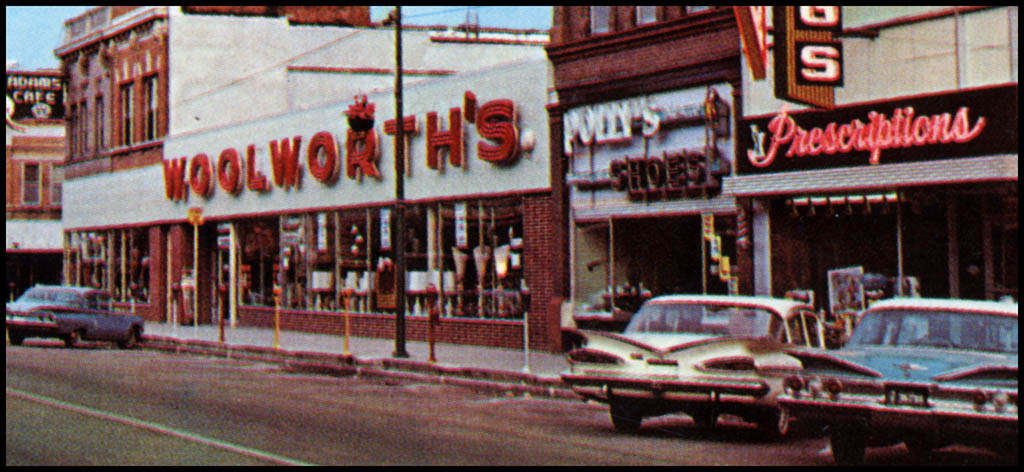
In Columbus, where I grew up, we had not one, but TWO, dimestores in our downtown. One was called Scott’s Dime Store. I think that one was locally owned. A block further down our main street was Woolworth’s, another dimestore.

CC_My-Childhood-Woolworths-Circa-1960s

Of course, during my formative years in Columbus, our main street was the only game in town. There was JC Penneys, Montgomery Ward, and a whole bunch of smaller locally-owned stores and cafes. Columbus also had two bakeries on our main street, one of which was the Gloor Bakery, and the other of which was the other bakery, which name we never spoke. Of course, Woolworth’s was a national chain, but we didn’t know that at the time. It was just another beloved dimestore, but one that included a lunch counter with much-sought-after booths by the window for your cherry coke.

Since my research suggests that non-baby-boomers are unfamiliar with dimestores, I will explain. Dimestores were (are there still dimestores in existence?) stores that carried a little bit of a lot of things at a reasonable price. Our dimestores carried things ranging from tennis balls to gold fish; from penny candy to sewing notions; from school supplies to kids’ shoes. Oh what fun it was to just wander into the dimestore and browse the aisles.

Scott’s Dime Store is where I bought my grandmother afghan kits that included everything necessary to make a ripple afghan. It is also the location of an incident about which my grandmother spoke the rest of her life. When I was 4 or 5 years old, she and I walked the two blocks between her apartment above our bakery and Scott’s Dime Store for reasons I have long ago forgotten. (It wouldn’t surprise me if the only reason we went was to kill time by browsing and perhaps (probably) to buy some candy. All I know is we were half the way back to her apartment when she glanced down and noticed that I was barefoot.

“Oy yoy yoy Krisily,” she probably said because oy yoy yoy was her universal term of surprise or frustration and –ily was added to every one of her grandkids’ names as a show of affection. “Where are your shoes?”

Oh boy, I thought. No clue.

So we walked back to Scott’s Dime Store and went up and down each aisle until we finally located my shoes. She put them back on my feet and I received, of course, not a single scold from her. In fact, she possibly bought more candy.

By the way, as another arm of research, I asked Bill if he knew what I meant by dimestore. He, of course, knew exactly what a dimestore was. He pointed out, however, that they called them 5 and Dimes instead of dimestores.

Big City shoppers!