Friday Book Whimsy: The Vacationers

searchBefore I purchase a book or even put a book on hold at the library, I will often look at Amazon to see what others thought of the book. I try not to be influenced too heavily because there are a LOT of books out there, and many people with varying tastes reading them. Still, it is unusual for me to choose to read a book that got over 1,000 reviews on Amazon with only a three-star average. In fact, The Vacationers, by Emma Straub, received more two-star ratings than five-star ratings.

Still, something about the plot grabbed my attention, and certainly the setting – the island of Mallorca, Spain – was unusual and intriguing. I’m glad I ignored the reviews and read the book because I simply loved it and recommend it highly as a great late summer read.

The Post family is just as dysfunctional as all of the rest of us. After 35 years of marriage, Jim is tempted into an affair with a young employee, and loses his job as a result. Wife Franny is trying to figure out how to deal with the hurt. Their teenaged daughter Sylvia will be leaving for college in the fall, and has the usual angst and eagerness. Son Bobby is just an all-around mess. They all have their own expectations about what they want from this vacation.

I found the characters to be realistic and quite likeable, even with all of their faults. I could relate to Franny’s hurt and confusion, and I found her to be someone with whom I could be friends and certainly could understand her struggle to figure out the future.

I particularly found Straub’s portrayal of Sylvia to be relatively realistic. The teen years are confusing and scary, and yet most teenagers think they have all of the answers. Straub’s Sylvia exemplified these teenage years quite well. Sylvia was suitably snotty, and yet even though she found her parents to be ridiculous most of the time (what teenager doesn’t), she loved them and reached out for them in her own ways.

In some novels, the setting almost becomes a character. While I got a nice feel for vacationing on an island in the Mediterranean, Mallorca itself didn’t become a distraction. I must say, however, it certainly is someplace I would like to visit some day!

There are a lot of characters, and Straub could probably have done without a few (particularly a Mallorcan boy hired to tutor Sylvia in Spanish – really?), each character had something to add to the plot. I particularly liked a storyline around Franny’s best friend, who along with his husband, accompanied the Posts to Mallorca. Their story made me smile.

The Vacationers is an interesting story about family dynamics set amidst the beautiful Med that has a satisfying ending. What wouldn’t you like?

Here is a link to the book.

unnamed

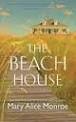
Friday Book Whimsy: The Beach House

searchI’ve read a series of rather dark and violently graphic mystery novels lately, so Mary Alice Monroe’s wonderful low country novel The Beach House was a welcome relief.

The author was recommended to me by someone who knew I enjoyed novels that take place in the south, and especially in the low country of South Carolina. I have enjoyed authors such as Dorothea Benton Frank and Karen White, and it pleases me to no end to become acquainted with another.

Cara Rutledge left home at age 18, eager to be away from her abusive father and the mother who seemed unwilling to provide any help or support. She makes a good life for herself in Chicago. But suddenly her life is in turmoil when she loses her job and her boyfriend in one fell swoop. A letter from her mother asking her to come home and repair their relationship is welcomed.

The story line itself is somewhat predictable, but in a laid-back low country way. The reader is swept up into the soft, slow, wonderful life in a beach house on an island off the coast of Charleston — Isle of Palms. You feel yourself relax and you taste the fresh crabs and the sweetness of shrimp caught just before eaten.

I’m not giving anything away when I tell you that Cara’s mom is dying of cancer. The reader learns of her imminent demise early on. Normally I feel betrayed by books in which a beloved character dies. In The Beach House, however, Cara’s mother Lovey is at peace with her diagnosis, making it less devastating and a part of whole story.

The side story is about the birth cycle of the loggerhead sea turtles, which Lovey and her island friends have watched and help manage for many years. I learned a lot about the sea turtles and found that side story interesting rather than distracting.

There is the inevitable love story, but I found it enchanting rather than sugary sweet. And of course you can’t have a novel about the barrier islands without a hurricane. Monroe does a nice telling of the details around the hurricane. Her characters were memorable and I wanted to spend time with them all. And I definitely want to own a beach house on Isle of Palms.

I will be eager to read more stories by this author.

Here is a link to the book.

unnamed

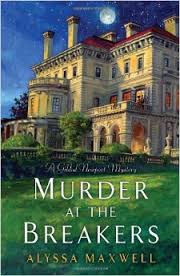
Friday Book Whimsy: Murder at the Breakers

imgresI’m a nut about historical fiction, so when I came across the first in a mystery series about life among the rich and famous in late 19th century America, I was hooked. Murder at the Breakers, by Alyssa Maxwell, is easy mystery reading at its best.

Fictional protagonist Emma Cross is a second or third cousin to New York industrialist Cornelius Vanderbilt. Her parents have moved abroad to be artists and have left Emma in the hands of the Vanderbilt family. While fairly distantly related, she is considered a member of the family and invited to all social activities among the rich who have their vacation homes in Newport, RI. The Vanderbilt home is called the Breakers.

The Breakers actually exists, and was really the vacation home of the Vanderbilt family in the late 19th Century. In fact, many of the rich New York Industrialists had homes in this area, so the fictional series is set in fact.

In this novel, Emma is attending the coming out party of the daughter of Cornelius and Alice Vanderbilt – a party that is documented to have actually taken place. However, in this fictional story, Mr. Vanderbilt’s financial advisor is murdered. Emma’s brother is found drunk and passed out in the bedroom from which the murdered financier was pushed, and quickly becomes Suspect No. 1.

Emma sets out to prove that her brother was not the murderer, and comes across a variety of interesting characters in the process.

The story reminded me much of Rhys Bowen’s fun “Her Royal Spyness” series in which the protagonist is 34th or 35th in line to become Queen of England. The main characters are alike in that, while distantly related to royalty (actual or perceived), they are nearly paupers. The series are both fairly light-hearted mysteries with elements of romance.

I recommend Murder at the Breakers to anyone who is a fan of mysteries but not interested in dark and sinister storylines. I found the book highly entertaining, despite the fact that I figured out the perpetrator early on in the book. But, after all, I read A LOT of mysteries.

Here is a link to the book.

Friday Book Whimsy: The Hurricane Sisters

searchI have always enjoyed novels by Dorothea Benton Frank, whose book settings are always somewhere in the Low Country of South Carolina. Her characters are always strong, if somewhat quirky, women, and the island settings always become at least a character of sorts. I always leave the story wishing I lived on an island off the coast of South Carolina, where I could just pop over the bridge and be in Savannah or Charleston.

However, The Hurricane Sisters fell significantly short of being a novel worth reading. Its only redeeming characteristic was that the settings were Charleston and the family home on Sullivans Island. Frank’s description of life on Sullivans Island made me want to pack up and move there. I could almost hear the ocean waves.

The storyline takes on the difficult subject of domestic violence. I would have preferred that the author write a nonfiction account of a serious problem that is apparently becoming more and more common in South Carolina. Addressing the subject in a weak fictional story almost seemed silly.

Frank presents three generations of Pringle women – Maisie, the matriarch; Liz, her daughter; and Ashley, Liz’s daughter whose desire is to make a career out of her talent for painting. Maisie is the strong-willed character always present in Frank’s novels, and really the only character who rang true at all. Liz is caught in a marriage that has lost its zing, and she compensates by putting all her efforts and emotions into her job at a nonprofit that works with victims of domestic violence, while at the same time ignoring her husband’s philandering. Ashley lives in the family home on Sullivans Island, and couldn’t possibly be a sillier character. Though apparently a smart and gifted artist, she spends the entire book mooning after a handsome state senator who is headed for greater things (the White House) despite the fact that he is clearly a perpetrator of domestic abuse.

It is simply laughable that Liz, who is so committed to fighting domestic violence simply dismisses Ashley’s roommate Mary Ellen’s attempt to convince her that the senator is abusive. Simply wouldn’t happen.

So many of Frank’s earlier novels are so much better. If you are interested in reading books with beautiful settings and interesting characters, pick one of her earlier novels such as Sullivan’s Island or Plantation.

Buy The Hurricane Sisters from Amazon here.

Buy The Hurricane Sisters from Barnes and Noble here.

Buy The Hurricane Sisters from Tattered Cover here.

Buy The Hurricane Sisters from Changing Hands here.


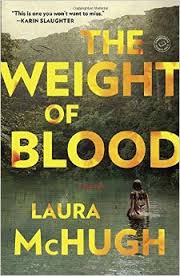
Friday Book Whimsy: The Weight of Blood

imgresMysterious characters, a large helping of suspense, dark family secrets, and a gritty southern rural setting – all elements that will call out to me and set me to reading a book. Laura McHugh’s debut novel The Weight of Blood has all of those elements and more.

The fact that the book was set in a poor area of the Ozarks in rural Missouri immediately reminded me of Daniel Woodrell’s creepy novel-made-into-a-movie Winter’s Bone, a book I liked 100 percent because of the setting. The Weight of Blood had the same sort of sinister atmosphere.

Lucy Dane’s mother apparently walked into a cave and disappeared when Lucy was a baby. Her disappearance has haunted both Lucy and her father Carl for almost two decades. How could someone who people say so loved her daughter abandon her?

Many years later, Lucy’s friend Cheri, a teenager who most believe is developmentally disabled, is found murdered and dismembered. Reminded of her mother, Lucy undertakes her own investigation. The harder she works at finding the truth, the clearer it becomes that her own family has its own sinister secrets. Running into roadblock after roadblock from friends and family alike, it becomes clear that lots of people know more than they are saying, and there are things she may not want to learn. Only her friend Daniel will help her find out the truth.

McHugh’s writing is good, and kept me reading into the night. At first glance, her characters seem to be black hat/white hat, but as the novel progresses, some of the gray begins to display itself. These are characters you don’t easily forget, even after the book is finished. McHugh paints a clear picture about what it’s like to live in a small town where everyone knows everyone else and blood is thicker than water.

The ending held little surprise, but was satisfying. I would recommend this book for the setting and the memorable characters, but only if you are in the mood for somber reading.

Here is a link to the book.

Friday Book Whimsy: Our Souls at Night

searchKent Haruf’s last book, Our Souls at Night, completed very shortly before he died and published in May, was one of the few books I’ve ever pre-ordered on Amazon. I simply had to own the book as soon as I could. But here’s the thing: I let the book sit in my library without reading it month after month, and for a simple reason. I could almost not bear reading the last words written by one of my favorite authors, knowing I would never be visiting the fictional town of Holt, Colorado, again. Well, except for the many times I will reread all of Haruf’s novels.

I read the book in one morning, and nearly in one sitting. That’s not an exceptional fact as the book is only 180-some pages long. I tried my best to read ever so slowly, savoring every word.

Our Souls at Night tells the story of septuagenarian Addie Moore, widowed for some time, who pays a visit late one evening to her equally-aged neighbor who had lost his wife years before as well. She has a proposal. Let’s sleep together. Not sex; just closeness and talking. The neighbor, Louis Waters, is understandably surprised. But upon taking it into consideration, he decides to give it a try.

What follows is a beautifully poignant story about love, friendship, aging, and family, and finally finding the meaning of life as they approach the end of life. As with all of Haruf’s novels, the story isn’t a driving factor. Instead, it’s about the characters and Haruf’s wonderful dialogue. As far as I’m concerned, there is no author better at capturing the way people really talk.

The story was joyful, but ultimately broke my heart, both because of the storyline (which I assure you doesn’t end tragically, just left a lump in my throat) and because it was the author’s swan song.

While Our Souls at Night can’t compare to his first novel, Plainsong, it was a wonderful final effort and a tremendous gift to his many fans.

I wish you could publish from heaven…..

Here is a link to the book.

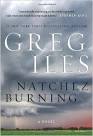
Friday Book Whimsy: Natchez Burning

searchI have mentioned before that I don’t normally do book reviews of books that are part of a series, unless it’s the first in the series. I certainly RARELY would do a review of a book that is fourth in a series. Yet, I feel I must express my opinions about Greg Isles’ Natchez Burning, because I can’t get the book out of my mind. That rarely happens to me, no matter how much I like a book.

Isles introduced his protagonist Penn Cage to us in The Quiet Game, a book published in 1999, and reviewed by me earlier this year. He had written other books, including Spandau Phoenix, a novel about Nazi criminal Rudolf Hess, a book that has somewhat of a cult following. I found Isles’ writing to be excellent and compelling. I subsequently read the other two books leading up to Natchez Burning. I found those books to be equally well-written, but disturbingly and brutally violent. Still, Natchez Burning was one of the most talked-about books of 2014, so I knew I wanted to read it.

One of the reasons it was so popular is that the author nearly lost his life in a car accident following the publication of the book preceding Natchez Burning. He lost part of one leg, and spent three years recovering. He also spent those three years writing a trilogy that is a follow-up to his previous Penn Cage novels. This back story led to an interest in this book by both his existing fans and new readers of his fiction.

In Natchez Burning, Cage learns that his beloved father, who is a well-respected family doctor, is being accused of murdering his old nurse. Cage quickly learns that there is more to his father than he ever knew. In his efforts to prove his father innocent, Cage is taken back 40 years to a time that might be better forgotten in the south, when the Ku Klux Klan was powerful and racial tension is beyond anything the reader can imagine. Greed and conspiracy abound.

If I have a complaint about the book, it’s that the bad guys are so incredibly evil that they are almost like cartoon characters. Caricatures, really. At least I hope so. And the story really is horribly violent. Every so often, I would let out a moan. Bill would ask me what was wrong, but it was simply my reaction to something unbelievably violent that transpired in the book.

Still, I can’t say enough about Isle’s writing. It’s what makes me keep reading the story, and then picking up the next. Because the book after this has already been published – The Bone Tree. I can’t wait to see what happens next, because Isles leaves us hanging at the end of Natchez Burning.

I cautiously recommend this book to fans of mysteries/thrillers. But it isn’t easy reading, just as his other novels aren’t easy reading. Hard to make a light-hearted read out of dog fighting and pedophilia. It’s incredible writing, however, which makes for a book that’s hard to put down.

Here is a link to the book.

Friday Book Whimsy: All the Light We Cannot See

imgresI’ve owned this book for quite some time, but I kept putting off reading it because there isn’t anything funny or uplifting about World War II (or really any war for that matter), despite Hogan’s Heroes’ best efforts. Much of the time, all I want to read is something easy and cheery. Admittedly, All the Light We Cannot See by Anthony Doerr is neither one of those. Still, it looks at WWII from a slightly different angle. And Doerr’s writing is lovely and it would be worth the read no matter the plot.

The winner of a multitude of prizes, including the 2015 Pulitzer Prize for fiction, All the Light We Cannot See tells the story of two young teenagers, one a blind girl living in Paris and the other a young German boy who lives with his sister in an orphanage in a small German town. Doerr tells their individual stories in a typical back-and-forth manner, chapter after chapter. In fact, the two don’t meet until near the end of the book, but nevertheless, they have a profound impact on one another.

Marie-Laurie’s father deeply loves and takes wonderfully good care of his blind daughter. But the German’s occupation of Paris requires they make their way, mostly by foot, to the French town of St. Malo, in northern France near the English Channel, where they stay with her great-uncle, himself severely impacted by his service during WWI.

Werner is an exceptionally bright young man whose intellectual gifts become apparent to the powers that be in Germany. As a result, he wins a place in a particularly brutal segment of the Hitler Youth. At first, he is thrilled with this honor. However, the sensitive young man eventually comes face-to-face with the horrors of Hitler’s Germany.

All the Light We Cannot See provides a fascinating look at something that always puzzled me – what happened when a German recognized the atrocities that were being committed in the 1930s and 40s. Didn’t anyone do or say anything? The answer, of course, is there probably wasn’t a lot a person could do or say.

The book is worth reading for the story itself. But mostly it’s worth reading for Doerr’s lovely writing. His prose is lyrical and his descriptions and metaphors are distinctly enviable to a writer such as me. It was a slow read because the reader doesn’t want to miss a single word. And the brutalities of the war make it difficult at times. Still, All the Light We Cannot See is a book that shouldn’t be missed.

Here is a link to the book.

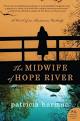
Friday Book Whimsy: The Midwife of Hope River

searchThink PBS’s wonderful series Call the Midwife meets the classic epic The Grapes of Wrath, and you will have a sense of the flavor and heft of Patricia Harman’s wonderful debut novel The Midwife of Hope River. Harman is, herself, a trained midwife, so her tale has a realistic and readable feel. Prior to this novel, Harman wrote a couple of autobiographical books about the science of midwifery.

In an effort to escape her past, our protagonist changes her name to Patience Murphy and moves somewhere where no one will find her – the Appalachian Mountains of West Virginia. She has some training as a midwife, and she uses her skills in her new home to provide services for the women of her town. The time period: just after the stock market crash of 1929.

Times are tough, and money is scarce. But Patience lives a good life far away from her past and delivers babies for blacks and whites, those with money and those without, without questions. After all, she has her own history. She is often paid in flour or corn meal or a freshly-killed chicken rather than money. It’s the Great Depression.

The story is slow moving, but told in a beautiful manner. We eventually learn about Patience’s past, but the author takes her time letting us know the truth. In the meantime, we get to know Patience’s heart, and can’t help but love her.

The Midwife of Hope River is a history lesson as well as a novel. It provides information about race relations, medical care in the early 20th century, midwifery, the dangers of coal mining, the Depression, and the fight for safe working conditions. But we are also told about the satisfaction of friendship and love.

Like Call the Midwife, there are vivid descriptions of childbirth. I was somewhat concerned that reading about birth after birth after birth would get old, but it didn’t. The details weren’t graphic, and the care and love shown by Patience and her apprentice, African-American Bitsy, makes for fine reading. You can certainly tell the author is a midwife.

I loved this book. I had never heard of it until I came across its sequel, The Reluctant Midwife, via Book Bub. I am looking forward to reading on about the characters of Hope River. Definitely a woman’s book, but one worth reading.

Buy The Midwife of Hope River from Amazon here.

Buy The Midwife of Hope River from Barnes and Noble here.

Buy The Midwife of Hope River from Tattered Cover here.

Buy The Midwife of Hope River from Changing Hands here.

Friday Book Whimsy: Calves in the Mudroom

Author Jerome O Brown provided me with a copy of his book, Calves in the Mudroom, in exchange for a fair and honest review.

searchI’m not particularly a fan of novellas. Much like short stories, I feel I can’t get a handle on the characters or their lives and thoughts in such a short format. Nevertheless, I agreed to take a look at first-time author Jerome O Brown’s novella, Calves in the Mudroom. The title alone caught my interest. I was glad I took the time, because I think it’s a great first effort for Mr. Brown.

Wade Summers is a high school-aged boy, part of an incredibly dysfunctional family that includes an alcoholic, self-absorbed mother and her abusive boyfriend. Until recently Wade lived a relatively happy life anchored by his grandfather. Upon his grandfather’s death, he is pretty much on his own.

Calves in the Mudroom tells the story of a day or so in Wade’s life, when all he wants is to be a perfectly normal teenager, which includes taking the most popular girl in school to prom. Unfortunately, events beyond his control bring about a different sort of night and provide the reader with a vivid picture of what life is like under such dire living circumstances.

Brown’s prose is stark and blatantly gloomy. Calves in the Mudroom isn’t an easy read. It isn’t supposed to be. But Brown’s descriptive narrative provides the reader with a clear picture of what life is like when roles are reversed and the child and parent exchange places.

If I have any criticism of Brown’s first effort, it’s that he tries a bit too hard with his descriptions. Having said that, I also feel that he provided such clear images that I could picture the events as clearly as a movie. I could smell and see Wade’s surroundings.

I frankly hope that Brown continues his writing and hones his skills because I would definitely like to sink my teeth into a novel with the slight (very slight) tinge of Kent Haruf.

Buy Calves in the Mudroom from Amazon here.

Buy Calves in the Mudroom from Barnes and Noble here.