Friday Book Whimsy: Vinegar Girl

41l0bsfq7yl-_sy344_bo1204203200_Bestselling author Anne Tyler is known for her quirky characters and her clever story lines, but in her most recent novel, Vinegar Girl, Tyler has some help from someone fairly reknown himself – William Shakespeare.

Vinegar Girl is part of the Hogart Shakespeare project sponsored by Hogart Press. The Shakespeare project provides readers with a variety of Shakespeare works retold as contemporary stories by a variety of well-known authors. Vinegar Girl is a retelling of The Taming of the Shrew.

I would love to tell you all the ways in which Vinegar Girl is better or worse than the original Shakespeare play; however, I’m somewhat embarrassed to tell you that I have never read it or seen it performed. Okay. I got that off of my chest.

Following her mother’s death, Kate Battista took over the care for her discombobulated scientist father and her pretty and conceited younger sister Bunny. She gave up her dreams of college and instead, cooks and cleans their home, tries to steer Bunny towards good decisions, and works as a preschool teacher.

Dr. Battista learns that his Russian research assistant is about to be deported, meaning they will have to give up on the research project they have been working on for many years unless they can find a way to keep him in the United States. Dr. Battista comes up with the idea of his daughter Kate – who seems unmarriageable anyway – marrying Pyotr to keep him in the US.

The storyline plays out in a way that is humorous and frustrating, delightful and infuriating, poignant and playful. The plot allows Tyler to write in her usual clever style, and while the Shakespeare play apparently ends with the main character explaining to her sister that she made her decision because men are sovereign, Tyler’s ending is absolutely perfect. Flawless. Charming.

I admit that though Tyler has always been one of my favorite authors, I haven’t liked her more recent novels quite as much as her earlier works. But Vinegar Girl left me feeling the way I always have felt – satisfied and wishing that I could spend time with the characters in real life.

Here is a link to the book.

unnamed

Friday Book Whimsy: The Tea Rose

51gej6fmykl-_sy344_bo1204203200_I like tea. I like roses. I like London. I like epic novels. I like the Victorian Age. The Tea Rose, first in a trilogy by Jennifer Donnelly, was right up my alley.

And, it was, indeed, a meaty look at the life of the Finnegan family, a hardworking Irish immigrant family living in the very poor Whitechapel area of east London during the days when factory owners held all of the power and a serial killer named Jack the Ripper was terrorizing the people of the area.

Young Fiona Finnegan works in a tea factory, and knows so much about tea that she can identify the type of tea simply by smelling and feeling the leaf. Since she was a small girl, she has known that she would marry the man she loves, Joe Bristow, whose family sells produce from carts in the East End. Fiona’s father works in the tea factory for extremely long hours and is paid a pittance while the owner brings home the big bucks. Her mother stays at home and keeps a house for Fiona, her two brothers and a baby sister. Mr. Finnegan, in an effort to earn a living wage for the tea workers, becomes involved in the creation of a union. He is killed one night by the owner for his efforts. That same night, Fiona’s family crumbles in a variety of ways, and eventually she and her young brother Seamus barely escape with their lives on a ship to New York City. There, she hopes to find her Uncle Michael who is the proprietor of a grocery store in the Big Apple.

In the way of most huge, epic novels, Fiona’s story is complicated and complex and interesting and scary and romantic. The novel is in the neighborhood of 600 pages long, so it’s impossible to tell you everything that happens, nor would it be fair to take the fun out of it. I will admit that if the author had allowed me to edit her novel, it would have been considerably shorter. I found the author to be such a great storyteller that I often couldn’t put the book down in my desire to see what happens next. Still, she went into a lot of detail when it came to the stories of what happens to Fiona and her friends and family. Many, many words. A lot of story lines. And many more coincidences than are even vaguely realistic. Just how often can Fiona and Joe pass within a block of one another or just miss one another by seconds?

Still, I really enjoyed the book, and loved the characters I was supposed to love and hated the characters I was supposed to hate. The romantic element was just as unrealistic as most romance novels, and yet I couldn’t help rooting for Fiona and Joe to find their way back to one another. I liked the descriptions of both London and New York City, and enjoyed seeing Fiona make her way from a poor tea seller to one of the richest women in the world. And heck, they even solve the mystery of who was Jack the Ripper!

The second in the trilogy is The Winter Rose, and I will be interested in seeing what happens next.

Here is a link to the book.

unnamed

Friday Book Whimsy: Settle for More

imgresWhile I’m a fan of an interesting biography, I’m not particularly a fan of memoirs, unless the writer has an exceptionally unique story to tell about themselves, which most don’t. Simply by definition, memoirs are bound to purvey a somewhat self-absorbed point of view. Still, I read Megyn Kelly’s memoir, Settle for More, because I always liked her when I would watch her on Fox News. She seems confident and very smart.

At the end of the day – or the book, as it were – I found her to be a good writer. Because of that, the book was easy to read. Unfortunately, I simply didn’t find her life that interesting. Certainly not interesting enough to warrant a memoir, at least not at this point in her life.

For the record, I am not one of the block of conservatives who are currently mad at Megyn Kelly for a series of questions she asked then-presidential candidate Donald Trump in the first debate. On the contrary, as a journalist by education, I think the questions Ms. Kelly asked a presidential candidate were fair. So my dislike for Settle for More has nothing to do with my feelings about the author.

Kelly was part of a family who encouraged hard work, and encouraged getting your own reward from a job well done. She made it a point, again and again, of saying that her family wasn’t one who believed in getting “participant” trophies, but instead, felt if you earned first place, you should get first place. I frankly find that admirable, but not terribly unique for that time.

She worked hard for her success, but so did (and do) a lot of other people. She came from a middle-class family, and so it isn’t even like she had to struggle to make ends meet in order to become educated. It’s true her father died when she was in high school, which is very sad, but unfortunately, lots of people lose one or both of their parents at a young age.

She worked her bottom off as lawyer before realizing that she had to give up too much of her life to be as successful as she wanted. Many people reach the same conclusion. It is clear that she worked hard for the success she currently experiences, and good for her. But her life seems to have been pretty ordinary, not really warranting the need for a memoir. For that reason, I can’t really recommend the book.

Here is a link to the book.

unnamed

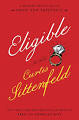
Friday Book Whimsy: Eligible

searchJane Austen’s Pride and Prejudice is a THING with a lot of people. You can find a whole section on Etsy for items relating to what is probably Jane Austen’s most well-known novel out of the six that were published. There are big-screen movies and made-for-television series and literary spin-offs and Facebook pages and annual gatherings of P & P fans. There is even a zombie movie version of Pride and Prejudice.

All of this for a book written by a young woman about whom shockingly little is known and who, despite the romantic themes of her books, not only didn’t marry, but likely died a virgin. And not a zombie virgin.

I downloaded the book Eligible by Curtis Sittenfeld sometime late last year because it was on sale from Amazon. I wasn’t even entirely sure what the book was about, and I had certainly not heard of the author. But $2.99? How bad could it be?

And then I didn’t read it for the longest time, partly because I discovered that it was a contemporary take on Pride and Prejudice. And while I have nothing particularly against that novel (which I haven’t read since high school), I also sort of took a stand against it in that way that I sometimes do because I hate being like everyone else and I get stubborn. It’s why I didn’t read Harry Potter books for a long time – everyone else was, and I wasn’t everyone else. But frankly, part of the reason why I didn’t read the book was because of the name of the author. How could a MALE AUTHOR think they could tackle such an endeavor as a contemporary version of Pride and Prejudice?

Dumb, for several reasons, not the least of which is that Curtis Sittenfeld happens to be a woman.

The plot is familiar. Liz and Jane Bennet have returned home from their lives in NYC to take care of their father who has had a heart attack. Their sisters Kitty and Lydia are too flighty to trust, and their sister Mary rarely emerges from her bedroom where she endlessly pursues master’s degrees via computer.

The Bennets have been high society in Cincinnati, but unbeknownst to Mrs. Bennet – who is much more concerned with finding husbands for her five unmarried daughters – they are flat broke.

Mrs. Bennet has ensured that Jane meets Chip Bingley, a doctor best known for his appearance on a television show Eligible, modeled after real-life The Bachelor.

Liz, in the meantime, has met and started knocking heads with Chip’s friend Fitzwilliam Darcy, a renowned doctor and peculiar fellow. Love and then complications ensue, just as in Pride and Prejudice. And if you are a fan of the original novel, you can imagine how it ends.

Still, after finally giving in and reading the book, I must admit that I really enjoyed it. It was a fun take on the original book, and interesting to see how the author handled the familiar situations. Like the original novel, Mr. Bennet was a dear, and it was impossible to not want to strangle Mrs. Bennet and the younger sisters.

I think this is a must-read for fans of P & P, but honestly, I think it is a cleverly-written novel that will be enjoyed by anyone who likes a great romantic romp. Don’t be crabby like me.

Here is a link to the book.

unnamed

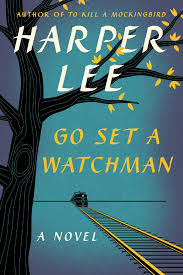
Friday Book Whimsy: Go Set a Watchman

urlIf you are a reader, and unless you have been living on Mars for the past couple of years, you know that Go Set a Watchman is a novel written by Harper Lee, best known for her amazing To Kill a Mockingbird. The controversy surrounding the book almost erases the value of this novel. While the publisher advertises it as a sequel to To Kill a Mockingbird, the reality is that it was the first novel submitted by Harper Lee long before Mockingbird. The publisher to whom she submitted the novel apparently told her it wasn’t ready for prime time and sent her back to the drawing board.

In Go Set a Watchman, a grown-up Scout, who goes by her given name Jean Louise, returns home to Maycomb, AL, from her current residence in New York City, to visit her aging father Atticus. Losing her mother at a young age, she has long hero-worshiped her father, and has tried to model her life after him.

Not long after arriving in Maycomb, after she finds an anti-Negro pamphlet among his things, she follows her father and a young man who she may – or may not – marry named Hank to a citizen’s council meeting where the speaker – who is introduced by Atticus – is a blatant racist who calls for the crowd to stop the rise of Negroes. Jean Louise is horrified, and spends the rest of the novel trying to make sense of what she has learned about her father.

According to what I’ve read, the publishers to whom the author originally submitted the story advised her to work further on the story, telling her that the most interesting parts of the book are the flashback scenes in which Jean Louise remembers growing up in Maycomb. Thus, you have To Kill a Mockingbird.

I had to remind myself throughout the book that it was written BEFORE To Kill a Mockingbird, as Jean Marie’s memories include things that are actually integral to her subsequent classic. For example, she recalls Atticus handling the legal case for a black man wrongly and unjustly accused of raping a white girl. Sound familiar?

The book really is more a series of vignettes up to the point in which Jean Louise confronts her father. That scene, along with a couple scenes featuring Atticus’ brother, make up the bulk of the novel, and really are the only parts of the book that make one think.

It’s difficult to imagine the world in the south back in the 1950s and before. Being so far removed, both in time and geographically, it was a wake-up call to be reminded that the Civil War had taken place less than a hundred years previous to the days around the Dred Scott decision. It was fresh in many people’s memory. Another point made by Jean Louise’s uncle that is remarkable is that only about 5 percent of the southerners who lived and fought and died in the Civil War actually owned slaves. For them, it really was a fight for states’ rights.

Sure, it was confusing and disappointing to see Atticus, but all-in-all, it wasn’t shocking.

The book would create fabulous discussion for a book group. I’m certain it already has.

Here is a link to the book.

unnamed

Friday Book Whimsy: Fiercombe Manor

searchI’ve mentioned  before that I love manor mysteries; you know, mysteries that take place in mysterious old houses with creepy caretakers or daunting housekeepers. So when a come across a book with the word manor right in its title, I am definitely going to give it a read.

Fiercombe Manor, a debut mystery novel by Kate Riordan, despite a few minor flaws, met, yes, even exceeded, my expectations. It was suitably creepy in the manner of Rebecca, the similarities a reader can’t fail to notice.

It’s 1933, and young and naïve Alice finds herself in a precarious position – pregnant by a married man who has no intention of leaving his wife after all. She confesses her situation to her horrified mother, herself a cold and unloving parent. The mother contacts her old friend Mrs. Jelphs, who is a housekeeper at Fiercombe Manor in Gloustershire, far away from London. The plan is for Alice to have her baby (which Mrs. Jelphs is told is the result of a brief marriage that ended when her husband was killed), then return to London and immediately give the baby up for adoption.

But when Alice arrives at Fiercombe Manor, (which is not occupied by the Stanton family who live abroad, but instead is lived in and managed by Mrs. Jelphs and a groundskeeper) she immediately begins to get creeped out by some of the noises she hears at night and stories she is told. Bit by bit, she learns of the homes’ former occupants. From that point forward, the story is told in the familiar back-and-forth style – Alice’s story and the story of Elizabeth Stanton. Sometimes I wish authors could be a bit more clever; nevertheless, both storylines are creative and compelling.

The book’s readers and reviewers draw a comparison between Mrs. Jelphs and Mrs. Danvers (the housekeeper in Rebecca). I don’t believe the comparison is justified. While Mrs. Jelphs clearly knows more than she is saying, she is ultimately kind and cares for Alice. Still, the whole notion of a young woman alone in a creepy mansion with only a suspicious-seeming housekeeper and a groundskeeper who keeps showing up in unexpected place clearly begs the reader to compare it to Rebecca.

There is a romantic element, as one of the Stanton heirs is a young man who has issues of his own. The romance doesn’t get in the way of the story, however.

I enjoyed the book very much, and found Riordan’s writing to be beautiful. I am looking forward to the author’s next book, which apparently will be a ghost story.

Here is a link to the book.

unnamed

Friday Book Whimsy: 2016 Favorites

pile-of-booksMy reading goal every year is 100 books. I’m not sure I have ever hit my goal, but I have come close. For example, in 2015, I read a total of 93 books. I’m afraid in 2016, I was a bit of a slacker, having only read 88 books – a couple of which were, quite honestly, novellas. In my world, they counted! Especially since I’m not graded on quantity. And I’m thankful I’m not rated on quality, because I don’t use the New York Times Book Review for my book choosing. Actually, I’m not graded on anything being retired and all….

Anyway, I post a book review each week, so if you are a faithful Friday Book Whimsy reader, you will be familiar with all of the books I am going to feature as my favorite five books of the year. The books may or may not have been published in 2016; they have just been read by me in the past year.  Frankly, most are books published in earlier years.

My five favorite reads in 2016, in no particular order….

Britt-Marie Was Here, by Fredrick Backman
Britt-Marie is a 60-something woman who leaves her controlling husband after she learns he is having an affair. She is compulsive and entirely set in her ways. She has been since she was a little girl and her much-adored sister is killed in a car accident. It should have been you, is the message that Britt-Marie got regularly from her mom, whether or not it was spoken out loud. So Britt-Marie begins the process of starting a new life. The only job she is able to find is the manager of a recreation center in a very small town. She has spent most of her life taking care of others and has no idea who Britt-Marie is and why anyone would care. But she learns that people do care, and begins to put together a new life where people accept her for who she is.

What I liked best about the book: Britt-Marie. I loved the main character so, so much. The book was entirely feel-good, and who didn’t need that this past year?

The Last Days of Night, by Graham Moore
The novel examines the invention of the light bulb, and the eventual replacement of gas lighting with electric lights in this entirely readable, eminently fascinating account of the legal battle waged between Thomas Edison and George Westinghouse. There is no one less interested in science than I, and yet I found the book to be fascinating. Moore uses real characters such as Edison, Westinghouse, Nikola Tesla, and Paul Kravath to give readers a snapshot of life in NYC in the late 1800s and how progress is REALLY made. It unexpectedly provided me with one of my favorite reads of the year.

What I liked best about the book: I love to learn about history and science via novels, as I find that so much easier to read. Moore was able to pique my interest in the notion of inventing and patents. It takes good writing to successfully accomplish that task.

Where’d You Go, Bernadette? by Maria Semple
This novel is everything I would hate in a book. The entire story is told via emails, text messages, flashbacks, school documents, and so forth. There is no driving narrative and virtually no dialogue. It is really all about the characters, but Semple does it so well that this book was a total pleasure to read. I had it in my library for a long time before I finally picked it up and read it, almost straight through. Bernadette is the star of the show, despite her quirky, agoraphobic nature. She is likable and believable. I would like to have her as my best friend. I don’t regularly reread books, but I will read this book again and again.

What I liked best about the book: The author’s characters are the best thing about the novel. Despite the fact that there is no driving narrative, she was able to paint clear and distinct pictures of each character through her unusual writing style.

The Nightingale, by Kristin Hannah
There is a plethora of novels available about World War II, and lots of good ones. I found The Nightingale to be one of the best I’ve read (and I’ve read more than my share) simply because it offered a different perspective on the awful war. Two sisters from a small village in France experience the war from entirely different perspectives – one as the woman and wife left behind to care as best she can for everyone around her, and one who becomes part of the French resistance. The look at the war from the women’s perspective, as well as Hannah’s beautiful writing, made this one of my favorite reads of 2016.

What I liked best about the book: There are many books – novels and nonfiction alike – about the horrific treatment of the Jews, and about the miserable conditions of the fighting men and women, but I liked reading about what it was like to try and keep your world in order under wartime conditions as the woman back home.

Tiny Little Thing, by Beatriz Williams
Christina “Tiny” Schuyler was the so-called good sister of the three Schuyler girls. She did everything the right way. She was good in school, she married well, and she was the perfect political wife to her ambitious husband. But what is missing is love. It made for a wonderful book with a thoroughly satisfying ending. Tiny Little Thing was the first book I had ever read by author Beatriz Williams, and I have read several since. They almost always have some connection to the Schuyler family, and they are very good. But Tiny Little Thing is my favorite.

What I liked best about the book:  Blackmail, adultery, Vietnam, dirty politics – all wrapped in a 1960s package. It took me a bit to get into the novel, but once I did, I couldn’t put it down.

unnamed

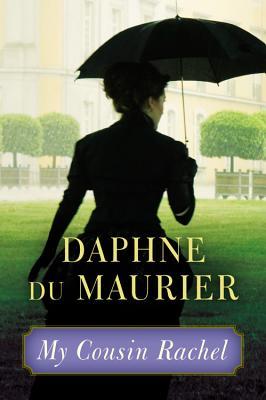
Friday Book Whimsy: My Cousin Rachel

18869970Back in 2014, I reviewed what is one of my favorite novels ever – Rebecca by Daphne du Maurier. At the end of that review, I said that I hadn’t read anything else by the author, and likely wouldn’t because the book would never compare to Rebecca and I would thus be disappointed.

Recently, I succumbed to temptation, and read My Cousin Rachel, by du Maurier. I was definitely not disappointed. What an exceptional novel. I simply couldn’t put it down.

Oh, don’t get me wrong. Nothing could compare the romance and intrigue of Rebecca, a book clever because the title character – who really is the main character of the story – is long ago dead and buried. The book also has one of the best opening lines of any novel: Last night I dreamed I went to Manderley again. Mysterious, yet sublime, once you have read the novel.

My Cousin Rachel also has an intriguing first line: They used to hang men at Four Turnings in the old days. Not anymore, though.

Young Philip Ashley comes to live with his cousin Ambrose as an infant upon the death of his parents. Ambrose – the master of an estate in the Cornwall section of England – is a good and loving guardian despite the fact that he is a confirmed bachelor. Ambrose and Philip are very happy together.

Ambrose is a confirmed bachelor, that is, until he takes a trip to Italy when Philip is 24 years old, leaving him to manage the affairs. He writes letters to Philip, telling him of his activities. Soon, he begins talking about meeting a distant cousin named Rachel. Via the letters, Philip learns that Ambrose eventually falls in love with Rachel, and they marry. But then the letters become further and further apart, until finally Philip gets a mysterious letter from Ambrose that implies that Ambrose believes he is being poisoned by Rachel. Philip travels to Italy, but it is too late. Ambrose has died, supposedly of a brain disease believed to have been inherited from his father. Rachel is nowhere to be found.

Philip returns home, deeply saddened and angry beyond words at Rachel. Eventually, Rachel comes to visit, and much to Philip’s surprise, he likes her very much. In fact, as the months go by, he becomes more and more attached to “my cousin Rachel” as he calls her throughout the book. And then mysterious things begin to happen to Philip as well…..

Du Maurier’s story telling is beyond belief. Her stories are creepy without being gory. The characters are multifaceted, the opposite of one-dimensional. Her plotting is creative without being silly. I forbade myself from looking at the end of the book (as I often do, I’m ashamed to admit), and didn’t. Yet, wanting to know how the book ends kept me reading late into the night. Like Rebecca, the house and grounds were almost a character. The author’s descriptions are vivid and allow the reader to feel like they are part of the story.

The ending was highly satisfying.

My Cousin Rachel is a wonderful book that I highly recommend, especially if you like gothic literature.

Here is link to the book.  

 unnamed

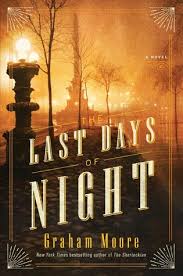
Friday Book Whimsy: The Last Days of Night

imgresWhen I was young, there was a section of the children’s area of our public library that featured a series of biographies ranging from Eleanor Roosevelt to Florence Nightingale to Booker T. Washington. I read them all.

And so I remember that I read all about how Thomas Edison invented the light bulb. That’s it. Nothing murky.  He was responsible for those light bulbs that we use every day of our life to light up our world.

But was it really that simple? Of course not; nothing ever is. What is unarguably true is that he was the first person to hold a patent for the direct charge light bulb.

The Last Days of Night, by Graham Moore, examines the invention of the light bulb, and the eventual replacement of gas lighting with electric lights in this entirely readable, eminently fascinating account of the legal battle waged between Edison and George Westinghouse, who had also invented a light bulb, but his used alternating current.

It’s hard to imagine that someone who cares about or understands science as little as I would enjoy this novel. Nevertheless, I loved this book. It will undoubtedly be among the top five books that I’ve read this year.

Not only could I not put it down, but I drove my husband (who studied engineering for a time in college) practically crazy with my unending did you knows.

Do you know the difference between direct current (DC) and alternating current (AC)? (He did.)

Did you know that they used alternating current (AC) the first time they used the electric chair, and it was a horrific and unimaginable failure? (He didn’t.)

Moore’s story begins in New York City in 1888. George Westinghouse hires a young, untested attorney named Paul Cravath to handle his literally billion-dollar case in which Thomas Edison is suing him over the simple question: who invented the light bulb.

Moore (who was the screenwriter for the wonderful movie The Imitation Game) uses real characters and real situations to tell an absolutely riveting story about the battle, which takes the young Cravath into the heights of society in New York City in the late 19th Century. His portrayals of the key figures – Edison, Westinghouse, Cravath, Nikola Tesla – paint a different picture from what I read in those little biographies as a child. They fought a seemingly unending battle over power – both electrical power and social power.

Don’t let the fact that this is a novel about the light bulb stop you from reading this book. It is an absolutely glorious story that involves corruption, romance, intrigue, and rollicking fun.

I have scarcely enjoyed a novel quite as much.

Here is link to the book.  

unnamed

Friday Book Whimsy: Belgravia

searchPeople who, like me, are still mourning the loss of our Sunday evenings with the Crawley family – Lord and Lady Grantham, the unpredictable Lady Mary and her sisters, the irascible yet loveable dowager countess, and the always loyal downstairs staff – take heart. Downton Abbey’s creator Julian Fellowes has written a book just for the likes of us.

Belgravia’s story begins on the eve of the Battle of Waterloo in 1815. The Duchess of Richmond holds a ball that is famous for decades as the highlight of social elegance. In addition to the standard social set, the duchess invited several newly-rich industrialists, shocking many of the aristocrats. A romance that is set in place at this ball between the son of an aristocrat and the daughter of a wealthy but not aristocratic working class man and woman sets off a string of intrigue, romance, scandal, and family secrets that would make Dowager Lady Grantham blush.

Fast forward to the 1840s, when secrets are revealed that set the story into play. Much like Downton Abbey, Belgravia has both the upstairs and the downstairs drama. The story, while admittedly predictable, is still fun and dramatic and a fascinating look at the mores of the the early- to mid-19th Century, when the Industrial Age was making common people wealthy.

Belgravia won’t win any literary awards. Fellowes’ novel reads more like a screenplay than a novel. But the characters are interesting and it’s fun to get a peek into their world, and the world around them. Unlike the Downton Abbey downstairs staff, the maids and cooks and butlers are not so good and open to corruption if the price is right. Lots of dastardly deeds.

A fun read for fans of Downton Abbey.

Here is link to the book.  

unnamed