
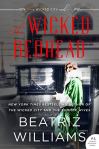
 Beatriz Williams: Oh, how you mess with your readers’ minds. Or at least my mind, because you had me so confused I didn’t know which way was up.
Back in 2017, Williams released Cocoa Beach, which is referred to as a “standalone novel,” meaning not part of one of her series. I reviewed that book here. I didn’t care for Cocoa Beach much, and was annoyed by the confusion created by references and ties to other of her books which readers may or may not have read. The author does this so often that she literally has a family tree available to readers to keep track of who is whom. But most annoyingly, she ended that book with reference to a redheaded woman and a man arriving at the home of the main characters, clearly in trouble. We are never told who they are or where they came from. Hello Sequel.
Well, if I had been paying attention, I would have recalled a redhead who escaped certain death at the end of another one of her novels, The Wicked City (a book I read but never reviewed).
Here it is, three years later, and we are able to access The Wicked Redhead, and finally tie the stories together. Interestingly, the publishers call The Wicked Redhead the second in “the Wicked City books,” never mentioning the standalone novel Cocoa Beach.
Having said all of that, I must admit that I liked The Wicked Redhead very much. Perhaps it was just because I could finally tie all of the stories together.
It’s 1924, and beautiful Ginger Kelly and her disgraced prohibition agent lover Oliver Anson Marshall arrive at the home of friends, running away from trouble and mayhem which left Gin’s evil stepfather dead. Accompanying them is Gin’s little sister Patsy. Mysteriously, Oliver is asked to return to his prohibition duties, leaving Gin and Patsy behind. It isn’t long before Gin is persuaded to undertake an odd duty by Oliver’s mother.
Meanwhile, it’s 1998, and Ella Dommerich (whom we met in The Wicked City) has discovered her husband is not only being unfaithful, but messing around with prostitutes. She leaves him, and quickly falls for her landlord Hector, whom we also met in that same book. She comes across some vintage postcards featuring a beautiful redheaded woman wearing little clothing. Having resigned her job, she has little to do, so begins researching this woman’s background.
It doesn’t take much imagination to tie the two stories together, but I will admit to being caught up in the process. Even though I find some of Williams’ tricks annoying, I will acknowledge that the woman can write a good yarn.
Some of the story is simply not believable, at least to this reader. Overall, however, I really enjoyed putting the pieces together.

 From the time I was a young girl, I loved reading advice columns. I savored Dear Abby and Dear Ann Landers as though my life depended on it. I couldn’t get enough. I’m not sure why people like me think a woman I don’t even know would be of any help to someone like me, but they were great successes. Dear Mrs. Bird, by A.J. Pearce, featured a World War II advice columnist.
 I’m not particularly a fan of beer. Oh, if I’m at a Mexican restaurant and the wine list looks suspect, I might make do with a Corona. For the most part, however, I stick to wine, gin, or whiskey.
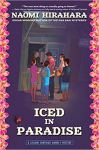 Ahhh. Hawaii. Tropical paradise. The last thing you would expect is MURDER.
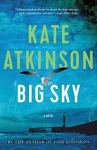 Way back in 2007, I first met Jackson Brodie in Case Histories, by Kate Atkinson. Formerly a police officer, Jackson was a private detective living in Edinburgh, trying to make a living working with insurance companies and helping people find missing animals. Brodie is a complex man who hasn’t had an easy life. He is divorced and struggles with a troubled past life.
 How can you not love a mystery story in which the protagonist is a librarian? I mean, who else would be better at locating a missing, well, anything?
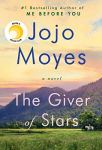 Jojo Moyes has written a good number of books. A couple have been made into movies, I believe. I, however, have read nary a one nor seen any movie made inspired by the author. Maybe I live on a desert island without any kind of media.
 1.
1.  2.
2. 3.
3. 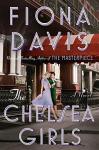 All of the author’s books to date have involved well-known places in New York City that add to her stories. The Chelsea girls takes place in the 1950s during the McCarthy period. The characters, who live in the historic Chelsea Hoel, represent several sides of the issue, and I not only found the book highly entertaining, but I learned a lot from reading it. Win-win.
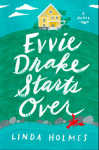 I loved this book. It might have been my favorite of 2019. Evvie is literally packing up her car to leave her abusive husband when she learns that he has had a massive heart attack which eventually kills him. Evvie feels so guilty and distraught that she can scarcely get on with her life. She meets a professional baseball pitcher who has suddenly and inexplicably tanked. The two fall in love, and save one another.
 Caren Gray grew up on Belle Vie, the Louisiana plantation where her mother worked as a cook and her great great great grandfather was a slave. The home has been in the Clancy family since the days when they owned slaves. Now she lives there with her young daughter, a single mother who manages the antebellum home which is now an historic venue.
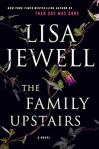 It isn’t often that I can say that I simply can’t put a book down. I read The Family Upstairs, by Lisa Jewell, in bed until I couldn’t keep my eyes open. I read the next day as a Lyft driver took me downtown. And I read on my way home as well. I had to know — HAD TO KNOW — what happens to this oh-so-complicated-and-disturbed family.
 Nana's Whimsies