
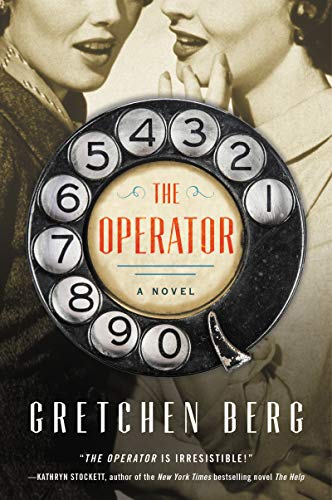
Where I grew up in the midwest in the 1950s, we didn’t have to go through an operator to make a phone call. We did, however, have a party line when I was in early elementary school. Mom told us under no circumstances were we to listen in to a phone call if we picked up the receiver and someone else was on the line. Being the obedient sort, I would immediately hang up if I heard someone else on the line. But man-oh-man, did I ever want to listen in on the conversation. The Operator, by Gretchen Berg, made me glad I didn’t succumb to temptation.
It’s 1952, and Vivian Dalton is an operator for Bell Company in the small town of Wooster, OH. Just like the own in which I spent my formative years, it was big enough that not everyone knew every other person, but it was a small world, nonetheless. There were the rich folks, or what my mom referred to as the Little 400, and what Vivian referred to as the Four Flushers. And there were the Working Class people. And there were the Bible Thumpers. And so forth…
And unlike me, Vivian can’t help but listen in on the phone conversations which she manages. She justifies it by saying she knows the people of Wooster better than anyone. She has what she calls intuition, and what her teenage daughter calls nosiness.
And then one day Vivian listens in on a conversation that she really wishes she hadn’t heard. It changes her marriage, her relationship with her daugher, in fact, her entire life. And she can’t unhear it.
Though I enjoyed the book, I wanted to like it a lot more than I did. I loved the 1950s setting. The way people lived and thought in those post-war days was captured very well by the author. My biggest problem with the book was that I really never grew fond of the main character, Vivian. Or at least not until the very end of the book.
And most problematic of all — at least for this reader — was the repetitive use of nursery rhymes throughout the book. It begins with the first paragraphs of the story, and continues on through the entire book. And there is never an explanation why.
The book was a reasonably good look at a 50s woman taking charge of her own life. Not a stupendous book, but one that kept my interest.

 I’ve always liked reading books authored by Joe R. Lansdale. They generally take place in east Texas, and there isn’t anyone who can make you feel like you’re standing in prickly weeds with sand in your boots better than Lansdale. While I have spent nearly no time at all in Texas, for some reason I’m drawn to books that take place in rural east and west Texas. I’m also drawn to books that take place in the 1960s, the era in which I spent my formative years.
 I love to learn things while reading an enjoyable novel. I have learned more about some of the landmarks of New York City from author Fiona Davis than I would have if I had read a history book on the magnificent city. Did you know, for example, that there was once an art school in Grand Central Station? I learned that in The Masterpiece, by the same author. Did you know that cattle used to graze outside of the Dakota Apartments, home to many famous people? You would if you had read The Address.
 I love author Beatriz Williams’ books. Most of them feature the Schuyler family, or some subset of that family. It’s fun to follow their paths. While I was fully aware that Her Last Flight would have nothing to do with the Schuyler family, being a fan of historical fiction, I looked forward to reading the author’s newest novel.
 Earlier this year when we were really pretty confined to our homes and there was little else to do but read, I read a surprisingly good novel called Daisy Jones & the Six, by Taylor Jenkins Reid. I say surprisingly because the format was very unusual, written as an oral biography. Normally I like more traditional formats. But once I started reading it, I was drawn in completely.
 I love mysteries and thrillers, and I thought I knew all of the established authors of books from this genre. So it was with great surprise that I discovered a three-book mystery series that began in 2014, written by Stephen King. I have not read King’s previous novels, because I’m not a fan of horror stories that involve snarling dogs or murderous cars. Give me a good ghost story any day. But I did read and review his memoir/writing textbook called
  Sometimes characters in books seem like paper dolls with painted on smiles and personalities that are ablaze with bright but unrealistic color. In The Distant Dead by Heather Young, the characters are complex and realistic, living with broken dreams and grit sprinkled with hope.
 I love books that take place during the days of the pioneers. Oh, I know. We aren’t supposed to like pioneers any more. I can’t help it. I find that period fascinating. I had an unusual break between books that have been pouring in from the library as of late. I took the opportunity to reread a book that I read many moons ago, and really enjoyed: These is My Words: The Diary of Sarah Agnes Prine, by Nancy E. Turner.
 For some reason, despite living right now in one of the most difficult times in my life thanks to COVID-19, the book styles of my choice has been mysteries and thrillers. Susan Allott’s debut novel The Silence caught my eye, and then delivered big time.
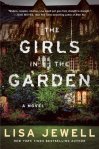 The idea of living in a gated community where children run around freely, in and out of each other’s houses, sounds delightful. But perhaps this freedom doesn’t protect the children as much as one might think. After all, sometimes the danger is within the gates. The Girls in the Garden, by Lisa Jewell, gives us a taste of that kind of a life.
 Nana's Whimsies