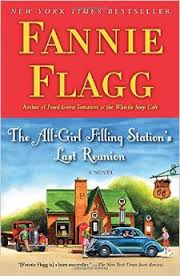
Friday Book Whimsy: The All-Girl Filling Station’s Last Reunion

imgresFannie Flagg knows how to tell a great story. I have felt this way ever since I read Fried Green Tomatoes at the Whistle Stop Cafe, which will always be one of my favorite books.

Reading anything written by Flagg is like sitting in a comfortable chair next to a fireplace listening to your grandmother or a favorite aunt tell you a story. The characters may be too quirky to be believable. The plot may wobble in parts. But you can count on a good story.

Sookie Poole is entering a new phase of her life. Her last daughter has gotten married and Sookie is looking forward to spending more time with her husband enjoying their life together. That is, until one day she opens a certified letter addressed to her mother – an erratic social climber who lives in an assisted living community and for whom Sookie has power-of-attorney. What she finds in the letter completely changes what she knows about her past, present, and future.

Sookie begins a quest to learn more about her past, and Flagg’s story begins.

Meet Fritzi and her family who run a gas station in the 30s in the Midwest. When TB puts her father in the hospital and World War II requires her brother’s services, the three girls take over the filling station. They also find their own ways to contribute to the war effort.

The more Sookie learns, the more confidence she gains in her own abilities. Trust Flagg to make you laugh out loud at some of the adventures Sookie faces. She reminded me of a great deal of Evelyn Couch of Fried Green Tomatoes fame. Tewanda! (Only pertinent to anyone who has read Fried Green Tomatoes.)

The All-Girl Filling Station’s Last Reunion was so much fun to read that I was sad to put it down.

Here is a link to the book.

unnamed

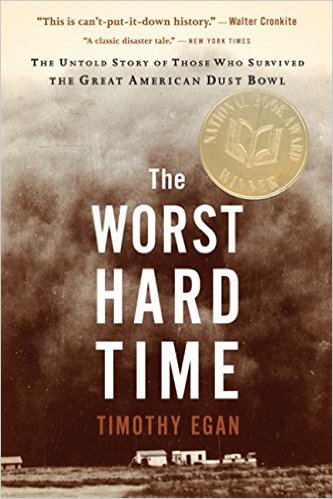
Friday Book Whimsy: The Worst Hard Time

518eRa9qECL._SX331_BO1,204,203,200_I don’t read a lot of nonfiction. However, if there is a topic in which I’m interested, a book about that topic that has received pretty good reviews will grab my attention.

The Worst Hard Time was such a book. Author Timothy Egan tells the story of the Great Dust Bowl of the 1930s in such a way that it almost reads like a novel. I’m interested in that period of time because my mother and father, having been born in 1926, would have lived through the Great Depression in Nebraska. Though they would have been children, since they lived so close to the area that is designated the Dust Bowl, I’m sure they felt the effects.

Egan tells the story largely through the lives of six or seven families. He takes us through the years leading up to the tragic drought, years that were wetter than usual. The wet weather, along with the need for wheat to feed the troops during World War I, led to plowing up land not meant to be farmed. Subsequently, the drought resulted in land that would normally have been held into place by the natural grasses being literally blown away.

Egan’s stories – really the stories of the families – give a clear picture of an almost-unbelievable period of time in our history. Dust storms, dust-caused illness, famine, insects, and wind, wind, wind that literally drove people mad are presented like a horror story.

I will admit that, not being a particular lover of nonfiction, I sometimes skimmed through information that was particularly scientific in nature or just of little interest to me. But mostly I was riveted to the stories of these amazingly strong and resilient people who lived in the Dust Bowl (the panhandles of Oklahoma and Texas, a large part of Kansas, southeast Colorado and southern Nebraska).

People must literally have believed that the world was coming to an end. And yet, the area survived.

A wonderful read for anyone interested in U.S. history.

Here is a link to the book.

unnamed

Friday Book Whimsy: Fallen Women

searchAuthor Sandra Dallas once again takes us to the Old West in the 1800s, this time to Denver during Gold Rush days. As we all know, the money from the gold in them thar hills brought about a variety of seemly and not-so-seemly enterprises. Establishments for prostitution abounded in the big city of Denver.

New York socialite Beret Osmundsen travels to Denver when she learns of the death of the sister from whom she was estranged. She soon learns that her sister was murdered. What’s more, her sister – herself a rich woman – was a prostitute and had been murdered at the house from which she worked.

Beret might be a rich New Yorker, but she is no weakling. Having devoted herself to working with poor women in NYC, she is familiar with some of the more unseemly aspects of life in the big city. She is determined to help the police detective in charge of her sister’s case find out who killed her sister, and more importantly, why. Though her murder appears to be the work of a serial killer, Beret is not so sure.

Fallen Women is a murder mystery, plain and simple. Many of Dallas’ stories are really more about relationships and character development, Fallen Women is about solving a murder.

I loved the characters in this book. Having read a lot of books that take place in the 1800s, both in London and in cities in the US, I am aware that in the 19th century, police officers and detectives were considered to be low-lifes, likely because most of them took bribes or were not willing to pursue a case unless they were compensated handily. I found this story interesting because the police detective who handled the case was from Denver’s high society and only worked as a policeman because it interested him.

Having lived so long in Denver, I really liked the fact that the story took place in downtown Denver. Thought the street names were different, I could envision where Beret was walking or where some of the places she visited were located.

There is a bit of a romantic element, but very unobtrusive to the main story.

I enjoyed the book very much, and would consider this to be one of my favorites by this author.

Here is a link to the book.

unnamed

Friday Book Whimsy: The Forgotten Room

imgresIt’s certainly not the first time several authors collaborated to write one book, but I believe it might be the first time I have read a novel written by multiple authors.

The long-awaited The Forgotten Room was authored by three well-known and prolific fiction writers, Karen White, Beatriz Williams, and Lauren Willig. The three “W’s”. Not too complicated to figure out how to alphabetize on the cover.

Willig is the author of a number of historical romance novels; White has written somewhere in the neighborhood of 20 novels, most taking place in the Low Country of South Carolina. Beatriz Williams has authored five or six period novels. I recently reviewed Tiny Little Thing, which may be one of my favorite reads of 2016 (though I recognize it’s only March).

I don’t know the back story of how these three authors came to write a novel. Nor do I know how they decided who wrote what. The details have been purposely kept secret.

The Forgotten Room is about three women in three different decades, all united in some way by a ruby necklace and a room in an upper New York City mansion. Olive lives in the late 18th Century, the daughter of the man who designed the house, but was mysteriously fired and subsequently committed suicide. She becomes a maid for the family living in the house to find out why her father was fired and never compensated for his work. A decade or so later, her daughter Lucy rents a room in the mansion, which in the Roaring Twenties has become a boarding room for women. Her goal is to find out who was really her father. And finally, Lucy’s daughter Kate, a physician, treats patients in the home which has become a hospital for returning war veterans.

All three women own the necklace at some point, and all three women have history in the forgotten room in the mansion.

I wanted to like this book. I expected to like this book. I liked the idea of this book. I just didn’t find myself drawn into the story.

As mentioned earlier, the authors have not revealed how the book was written. They purport that it was written in round robin style as opposed to each author taking charge of one of the characters. I will say that the writing styles were seamless. I couldn’t tell who wrote which chapter.

But I will also tell you that I just didn’t ever grow to care one bit about any of these three women. Their stories were illogical and implausible. I am fully willing to ignore the implausibility that takes place in most romantic stories. This time, I just couldn’t forgive it.

Each author has a novel coming out soon, and I can’t wait to put this one behind me.

Here is a link to the book.

unnamed

Friday Book Whimsy: All the Stars in Heaven

searchI think it’s fun to imagine the way Hollywood was in its glory days of the 1930s, 40s, and 50s – the days of rolled hair and perfectly drawn bowed lips lush with red lipstick. The days when stars were loyal to their movie studios and cognizant of being role models to their fans.  When movies almost always had happy endings.

That’s what I liked best about All the Stars in Heaven by Adriana Trigiani. Her novel painted a picture of Hollywood as it once was, which is very different from the way Hollywood is today.

Trigiani’s books sort of run the gamut. Her Stone Gap novels take place in the mountains of Virginia. Some of her books take place mostly in Italy. She writes of family and food and romance. She has written books aimed at teens. She has written nonfiction books about eating and cooking with her large Italian family.

But as far as I know All the Stars in Heaven is the first time she’s tackled a novel about real-life people.

All the Stars in Heaven tells the story of Loretta Young and her relationship with Clark Gable. It is fact that Young had an affair with Gable while they were filming The Call of the Wild in 1935. It is also fact that Young had a child from this relationship. Since studios would have nothing to do with stars who committed adultery (or at least stars whose fan’s found out about the adultery), Young had to keep the baby a secret. She had the baby quietly, placed her in an orphanage until the baby was a year-and-a-half, and then brought the baby home, telling the world that she was adopted.

All the Stars in Heaven follows her story quite accurately, if Wikipedia is to be believed (though apparently in real life Young later said she had been date-raped by Gable and the novel makes no mention of that allegation). What the novel DOES make mention of are wonderful stories about some of the movie stars of old. It’s kind of like reading a movie magazine that was published in 1950.

urlI knew very little about Loretta Young, though I remember her from her television show that ran in the late 1950s and early 1960s. And I remember that she was lovely. Spectacularly beautiful, in fact.  I didn’t know, for example, that she was a devout Roman Catholic her entire life. And if the novel accurately portrays Young, she also had a long-time friendship with Spencer Tracy.

See what I mean? Lots of juicy move star facts. Myrna Loy. David Niven. Carole Lombard.

Trigiani presents a fictional character – Young’s longtime secretary and friend Alda – who, in my opinion, really adds nothing to the story. I don’t quite understand why the author felt the need for this character.

All things considered, I enjoyed the book very much. It is perhaps not the best thing Trigiani has written, but it was sort of like standing in line at the grocery store and quietly paging through OK Magazine.

It was a fun read.

Here is a link to the book.

unnamed

Friday Book Whimsy: The Butterfly’s Daughter

searchAuthor Mary Alice Monroe is quite prolific, and I haven’t ever read a single book she’s written. That always surprises me, because I read a lot. From what I can tell, many – if not most – of her novels take place in the south, primarily the low country of South Carolina. I think most also contain some sort of environmental element, though I can’t say that for sure because, well, see above. First one I’ve ever read.

I’m saying this so that you will understand that I can’t compare this book to any of her other novels, as many reviewers have done. Having said this, I will tell you that I found it to be a pleasant, if not compelling, story.

Luz Avila lives with her grandmother in Minnesota, having been deserted by her mother when she was a small child. Luz believes that her mother is dead. Her abuela (grandmother) announces one day that she wants to travel with Luz back to the small town in Mexico where she was born and reared, stopping in San Antonio on the way to introduce her to other family. Luz declines, and the inevitable happens. Grandma dies. Luz decides to make the trip of which her abuela had dreamed, taking the ashes back to her home town in Mexico.

Driving a beat-up Volkswagen bug, and armed with her grandmother’s ashes, she sets off on a journey that her grandmother would have loved. Along the way, Luz meets a variety of people who have a surprisingly profound impact on her life given that she only knows them a brief time.

While not great literature, The Butterfly’s Daughter was a lovely book that contained some of the elements I like most when reading – interesting information (in this case, the flight that monarch butterflies make yearly from the northern United States to Mexico), delicious sounding food (in this case, Mexican food that made my mouth water), and a bit of romance (just a bit, not too much).

If you are looking for a light read with characters who are, while not unforgettable, at least likeable and interesting, The Butterfly’s Daughter will offer you enjoyable experience.

And if nothing else, read it for the food and the butterflies.

Here is a link to the book.

unnamed

Friday Book Whimsy: Tiny Little Thing

searchTiny Little Thing is the first book I’ve read by Beatriz Williams though she has written quite a few other novels. I will give you one simple fact: I couldn’t put this book down.

True story. The day I read the bulk of this book, I got something like 900 steps on my Fitbit. I sat in the chair and read the entire day.

Having said that, I will also tell you that it took me a bit to get into the story, and I’m not entirely sure why. Perhaps it was because I had just finished an exciting mystery story, and the tempo of this book is not exhilarating. However, once I got to know the characters and became familiar with what they were up to, it was all I could do to keep myself from reading the ending before I was halfway through the book. I was CRAZED to find out how Tiny’s story ended.

Christina “Tiny” Schuyler was the so-called good sister of the three Schuyler girls. Tiny did everything the way she should. She was pretty (though not as pretty as her sister Pepper), she excelled in school, she married well, and she was the perfect wife to an up-and-coming politician who was being groomed by the ambitious Hardcastle family to be president someday (ala, the Kennedys).

But things are not always as they seem, and secrets abound in the Hardcastle clan. Troubles for Tiny begin a couple of weeks before her wedding, when circumstances throw her into the hands of someone who could change her life just two weeks before she is to wed Frank Hardcastle. Nevertheless, the wedding takes place, but Tiny’s story has just begun.

Blackmail, adultery, Vietnam, dirty politics – all wrapped in a 1960s package.  It made for a wonderful book with an absolutely satisfying ending.

Apparently the characters in this book have been featured in several of the authors other novels, and now I have to read them all!

Here is a link to the book.

unnamed

Friday Book Whimsy: Bread and Wine: A Love Letter to Life Around the Table With Recipes

imgresJen gave me Bread and Wine by Shauna Niequist for Christmas, knowing and understanding how much I like to cook and how much I love cookbooks. I browsed through it, thinking it looked interesting, but kind of forgetting I owned it as I plowed through novel after novel – over 11 books since the first of the year. It was a cookbook, after all. It could wait.

Or so I thought….

Shauna Niequist is a writer, blogger, wife, and mother of two. She has written two previous books of essays, as well as a 365 day devotional, none of which I’ve read, or even heard of prior to reading this book.

Bread and Wine: A Love Letter to Life Around the Table With Recipes, is not, as the title would indicate, a book about hanging out with recipes (the title could have used a comma). It is a series of essays in which the author talks about the importance of food –preparing it, sharing it, and eating it – to strong family ties and close friendships, as well as personal happiness. Though it does, in fact, contain some recipes (thus explaining the title), it is definitely not a cookbook.

When I got out of the hospital a few weeks ago, I simply wasn’t in the mood to read one of my graphic mysteries or complicated novels. My mind wanted something simple upon which to spend my reading time. Jen encouraged me to begin reading Bread and Wine, and I was ever so glad that I did. Niequist is a lovely writer and I enjoyed every one of the essays. She captured my thoughts about food and cooking perfectly.

The author is a Christian writer and talks some about the importance that her faith plays in her life, but this isn’t a book about being Christian. It is, however, a book about enjoying life and knowing what is important and how to prevent negative thoughts and feelings from taking over our life. It is about friendship and love and coping with life in positive ways.

And some of the recipes look really good……

Here is a link to the book.

unnamed

Friday Book Whimsy: The Nightingale

imgresWhen a reader picks up a book about World War II, you pretty much know that it’s going to be difficult reading. Sometimes I wonder why we read such stories when they are so hard to comprehend and so utterly impossible to imagine. I guess the answer is that we read them so that we never forget what must be considered one of the most horrific periods in history.

So I knew when I picked up The Nightingale by Kristin Hannah that it wouldn’t be a light and breezy read. But it offered (and delivered) a look at the war from a new perspective – not the Jews who were persecuted and killed in or barely survived concentration camps but the rest of the European population who suffered immensely as a result of the Nazi regime.

What’s more, The Nightingale also offered a look at the war from the women’s perspective. Not nurses or others who participated directly in the war effort but those who were left behind to try and keep the world turning and their families safe.

Vianne and Isabelle are sisters who live in the Loire region of France. They haven’t had an easy time of it because their mother died shortly after their father returned from serving in WWI. The war changed him forever and he turned his back on his daughters.

The two took different paths in life – Vianne falling in love, marrying and having a daughter; Isabelle not able to find peace at one boarding school after another. When the Nazis invade France, both women experience the war in very different – but equally important – ways.

Hannah’s descriptions of the lives of the two women is vivid and graphic – and horrifying. The book took me by storm. I couldn’t put it down, but I found it hard to bear as I read.

The book is told from three perspectives – Isabelle’s (who becomes a resistance fighter), and Vivianne (who nearly loses everything trying to keep her family (and others) alive. The third perspective is contemporary and the reader isn’t sure whether it’s Vianne or Isabelle who is narrating that perspective.

I can’t recommend this book enough. It is a story I will long remember.

Here is a link to the book.

unnamed

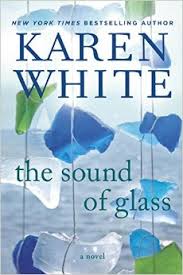
Friday Book Whimsy: The Sound of Glass

imgresAuthor Karen White has written somewhere in the neighborhood of 20 novels. I’ve read a handful with mixed opinions. Mostly positive, I’m happy to say.

The Sound of Glass was by far my favorite to date.

Based on my somewhat limited sampling, it appears White attempts to address a fairly serious issue in each of her novels. In The Sound of Glass, she tackles the very serious subject of domestic violence. Domestic violence, of course, is a topic that makes us cringe. White’s handling was done with an adept hand and lots of grace. Her story, however, also requires a fair amount of suspension of reality. That fact doesn’t deter from the fact that this is an interesting story with likeable characters.

The primary character is Merritt, whose husband Cal, a fire fighter, recently died on the job. Much to her surprise, she learns soon after that his grandmother has left him (and so now, her) the family home in Beaufort, South Carolina. Needing a change, Merritt leaves her Maine home to move to South Carolina to take up residence and refurbish her husband’s family’s home.

Through flashbacks and conversations with others, the author weaves the tale of three generations of domestic violence survivors. In addition to that topic, however, we also are given the opportunity to meet one of my favorite characters, Merritt’s stepmother Loralee. Loralee is only five years older than Merritt, and the mother of a 10-year-old son, Merritt’s half-brother Owen. The pair shows up uninvited on Merritt’s Beaufort doorstep, and changes Merritt’s life forever.

There is romance, and a bit of mystery and characters that are hard to forget. One of the things I like best about Karen White is that her books often take place in the low country of South Carolina, and her descriptions are vivid and beautiful.

There is just enough romance to be fun, and just the right amount of mystery. I enjoyed the book very much.

Here is a link to the book.

unnamed