Friday Book Whimsy: The Spider and the Fly

Before I review this book, I have to tell you a deep, dark secret. I sort of, kind of, like to read about real-life murder and real-life murderers. Don’t get me wrong; I don’t intend to embark upon a killing spree ala Natural Born Killer, a movie I’ve never even seen. And what’s more, though I may be unique in that I admit it, many people are interested in murder. (I wish I could say it like the British do: muuuurdah.)

Anyway, I know I’m not the only one because podcasts about murders and murderers are wildly popular these days. My Favorite Murder is one of the more popular podcasts out there nowadays. (I don’t recommend it for everyone. Language, people.)

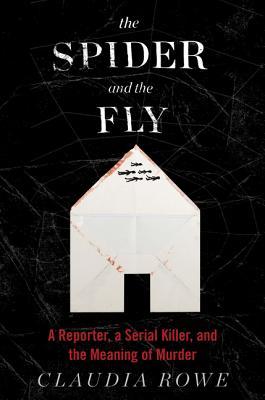
Anyway, The Spider and the Fly, by journalist Claudia Rowe, showed up on Book Bub, recommended for those who like nonfiction books that read like novels. As I am not a huge fan of nonfiction, this caught my eye, and I looked at the list of books. This one appealed to me because in the publisher’s description, it highlights this letter from real-life serial murderer Kendall Francois to the author:

Well, well, Claudia. Can I call you Claudia? I’ll have to give it to you, when confronted at least you’re honest, as honest as any reporter….You want to go into the depths of my mind and into my past. I want a peek into yours. It is only fair, isn’t it?

Oh my heavens. Doesn’t that sound like Hannibal Lector of Silence of the Lambs fame? I was hooked, and got my hands on the book as soon as possible.

Kendall Francois was convicted of killing eight women in Poughkeepsie, New York, between 1996 and 1998. What’s more, he kept these eight women in the attic of the home he shared with his mother, father, and a sister, who took no offense at the putrid smell coming from the attic and the appearance of maggots on their ceiling. Seems odd, doesn’t it?

Francois eventually confessed to the inept police (who had also visited the home, and it hadn’t raised any concerns), pleaded guilty, and was sent to live out most of the rest of his life at Attica prison. He eventually died of cancer at another prison in his 40s.

It was shortly after his confession that Ms. Rowe became interested in the murder and Francois himself. What, she wondered, could make a person become a serial murderer.

The book, however, is as much about the author and her messed-up life as it is about Kendall Francois. So if you embark on this reading journey thinking you will gain an understanding of why a person murders, you will be disappointed. Rowe becomes obsessed with the murderer because she thinks it might give her some insight into her own weird life.

By the way, despite the fact that Francois was a real-life murderer, he wasn’t as scary as Hannibal Lector because who could be?

This book is certainly not for everyone. The details are disturbing, and the fact that it is real stuff makes you want to not go out at night. Still, I admit that I enjoyed reading this book, though I might stick to murder mysteries from here on.

Here is a link to the book.


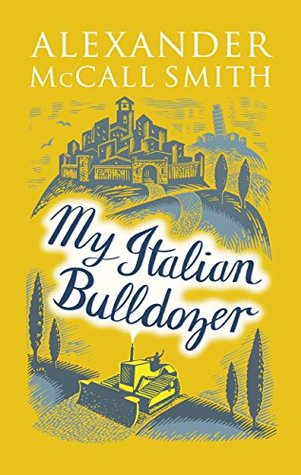
Friday Book Whimsy: My Italian Bulldozer

When I stumbled upon this book from one of my daily book finds – I think it might have been Good Reads – the title was so odd that I nearly ignored it. And yet, the title was so odd that I couldn’t help but pay attention.

And I am very familiar with author Alexander McCall Smith, mostly from his Mme Ramotswe books featuring the No. 1 Ladies Detective Agency located in Botswana, Africa. As far as I’m concerned, Smith’s books feature some of the most endearing characters in all of bookdom. Precious Ramotswe is the Father Tim (of Mitford fame) of Africa.

But seriously? An American man who drives around Italy in a bulldozer?

Paul Stuart is a world renown and respected cookbook writer who is in a slump because his girlfriend left him for her personal trainer. To help get him back on his feet, his long-time friend and agent sends him to Italy to research his next cookbook about Tuscan cooking.

Alas, when he arrives at the rental car agency near the Tuscan village of Montalcino, where he is to spend the next few months researching food and wine, he learns that all of the cars are rented out. He is frustrated and ready to go back home, when he learns of the availability of a bulldozer.

Yes, a bulldozer. A big yellow bulldozer.

Not wanting to return home, Paul makes the admittedly unlikely decision to go ahead and rent the bulldozer, and begins a set of adventures in which he learns to slow down, love more, enjoy great food and wine, and form unlikely friendships.

I found the book to be utterly charming. There are no great morals or lessons. It’s just a snapshot of Italian life and what you really need from your friends, as seen from the upper berth of a bulldozer. Bill and I have spent considerable time in Tuscany, and even visited Montalcino (where our GPS mistakenly had us drive to our next destination through a vineyard).

It is a quick read, just this side of a novella. And I smiled throughout.

Here is a link to the book.

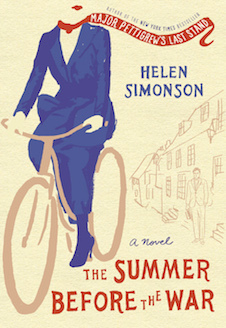
Friday Book Whimsy: The Summer Before the War

Touted as a replacement for Downton Abbey, The Summer Before the War, by Helen Simonson, the story didn’t fill that niche at all for this reader. Nevertheless, I found it to be an interesting story.

Much like Major Pettigrew’s Last Stand, also by the same author, I found The Summer Before the War to be difficult to sink my teeth into. Once the story caught me, I mostly enjoyed the book despite some misgivings.

It is 1914, and there are rumblings of war. Nevertheless, encouraged by a strong-willed woman whose husband has political connections, the little town of Rye in East Sussex, England selects Beatrice Nash to be the Latin professor in the local school. A woman teaching Latin? And a young and attractive woman to boot? Unheard of!

Beatrice is mourning the death of her beloved father, himself a professor. He has left her without a penny to her name, but with lots of ambition and a strong head on her shoulders. She is ready to take on the naysayers who doubt her abilities. It is the summer before the war that no one actually believes will take place.

Agatha – her outspoken supporter – along with her two nephews, both as different as night is from day and devoted to their aunt, roll with the punches as they fight the battles against the townspeople and eventually the actual battles against Germany.

Simonson’s novel paints a clear portrait of the impact that war has on those fighting the battles on the field and those fighting to keep their homes and their families together. Her characters are well-drawn and interesting. The novel has unexpected twists, and an ending that I wouldn’t have predicted. It was a surprise, if somewhat confusing.

Overall, I enjoyed the book. I found it a bit slow in parts and can’t quite explain the ending. Still, it’s worth a read, especially if you read and enjoyed Major Pettigrew’s Last Stand.

Here is a link to the book.

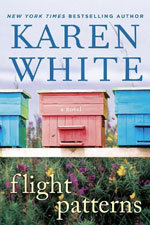
Friday Book Whimsy: Flight Pattern

Karen White is one of the more prolific authors whose books I read. I have found some to be really good and some to be not so good. Flight Patterns was not only really good, I think it might have been the best that I have read to date.

First of all, it incorporates beekeeping into the storyline. And since members of our family have taken up beekeeping (read this post), it is a topic of utmost interest to me. White begins each chapter with a fact about bees, and I found that in and of itself very interesting and fun. Though bees are part of the story, the story itself is not about beekeeping. So if bees aren’t your thing, don’t let that discourage you from reading this very good novel.

Georgia Chambers has been estranged from her family for 10 years. She resides in New Orleans, where she works with china, mostly antique Limoges china. She knows everything there is to know about china patterns, which is what brings her new client James Graf to her. He has found amidst his things a couple of pieces of very unusual china that bears a bumblebee pattern, and he wants to find out the history.

This leads to that, and Georgia finds the need to go back to her home of origin in Apalachicola, Florida – a real town located in the panhandle of the state, on the Gulf of Mexico. She has not seen her sister Maisy, her mother Birdie, or her grandfather (who is an apiarist) since something devastating happened 10 years earlier. Just what that event was is kept a secret throughout the book, with just bits and pieces of clues provided the reader. All we know is that Birdie hasn’t spoken  a word since then, and Maisy won’t have anything to do with Georgia.

The character of Georgia was one of the most interesting characters of any Karen White novel I’ve read. She was private, cold, and yet likable. The pain she feels by being separated from the family she loves so much is spelled out so clearly, I could feel her pain myself. Maisy’s anguish and Birdie’s – well – craziness, are handled in such a way as to not make them disagreeable characters, only troubled.

As all of the pieces fall into place, the reader begins to understand what created such a divided family. The ending was satisfying and not schmaltzy.

Flight Patterns might be one of my favorite reads of 2017.

Here is a link to the book.


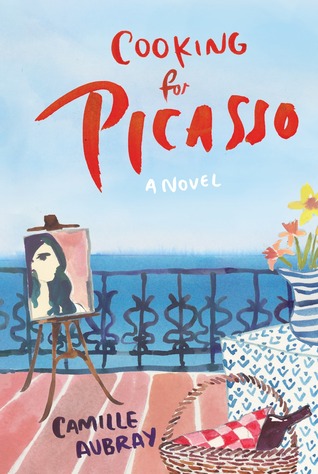
Friday Book Whimsy: Cooking for Picasso

After recently reading a disappointing book that was based on cooking, I was somewhat reluctant to pick up Cooking for Picasso, a novel by Camille Aubray. Still, it came highly recommended by a reliable source, so I gave it a try.

I will admit that for whatever reason, it was a slow start for me. But once I became connected to one of the main characters – Odine – it was a novel I couldn’t put down.

I say “one” of the main characters, because Cooking for Picasso has that now oh-so-familiar novel style of having a main character who lives in contemporary time and a second main character who is connected to the first, but of an earlier era. In this case, the contemporary character is Celine, a Hollywood makeup artist who is somewhat discontent with her life. She learns from her mother that her grandmother Odine had once cooked for Pablo Picasso in the Cote d’ Azur village in France in which she lived. Her mother encourages Celine to travel to the little village and learn more about her grandmother.

It is 1936 and Odine was a 17-year-old village girl who worked with her parents in their restaurant. She is given the assignment of preparing and delivering lunch to the great artist Picasso, who is secretly living in the village to paint and rest. Though she is charged with discretion and privacy, Odine comes to know Picasso initially because he is so impressed with her simple, yet delicious, rustic cuisine. Eventually they develop a relationship, and Odine learns about art and food and life itself.

Years later, as Celine begins to learn the truth about her grandmother, she learns about art and food and life as well.

I must admit that this reader learned a lot as well, mostly because every time the author would talk about a painting, I would quickly look it up to see it for myself. And her descriptions of the delicious meals Odine would prepare literally made my mouth water.

I understand Cooking for Picasso is a novel, but it also painted a picture (did you see how I did that?) of life in France during largely difficult times, and how some survived.

It was a wonderful novel. And now I want to eat French food.

Here is a link to the book.

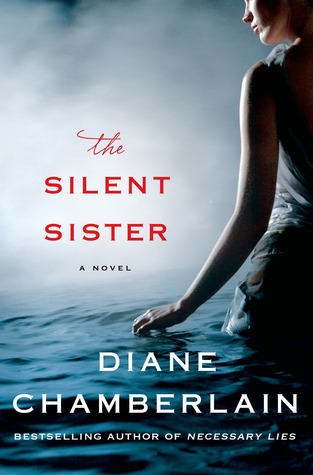
Friday Book Whimsy: The Silent Sister

Despite the fact that I had only previously read only one book by this very prolific author – and didn’t particularly like it – I gave this one a try. I had read a series of books that didn’t satisfy. They were either extremely dull or extremely violent. Sometimes I can take a bit of violence; I can never take dullness.

I found The Silent Sister, by Diane Chamberlain, to be quite enjoyable. It was neither dull nor violent, though the story was action-packed. I’m not sure if I was just in the right mood for the story, but this was a book that, if it wasn’t true that I couldn’t put it down,  I at least looked forward to picking it up and reading it.

The main character Riley’s sister Lisa supposedly committed suicide when she was a teenager, following the murder of her music teacher. Lisa was suspected of the crime; hence the suicide. Now, years later, Riley’s parents are both dead, and Riley finds herself going through their things to prepare the house for sale. In the process, she finds documents that suggest that Lisa is not, in fact dead at all, but merely living elsewhere under an assumed name.

Riley is understandably perplexed and begins to try to find out what’s going on. In the process, she discovers that there are secrets about her family – particularly her father – that she would never have suspected.

The plot had many twists and turns. While the outcome was admittedly not a total shocker, the process getting there, and the author’s writing style, kept me interested until the very end.

I don’t think this novel would fool many people, I still can recommend the book as a very enjoyable read that will keep you on your toes to try and stay one step ahead of Riley.

Here is a link to the book.

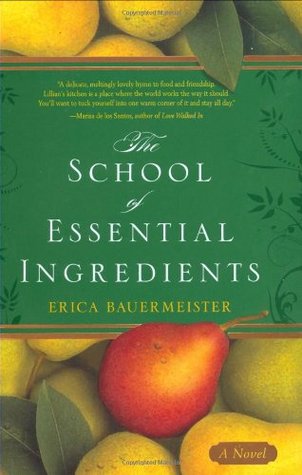
Friday Book Whimsy: The School of Essential Ingredients

Erica Bauermeister’s novel,The School of Essential Ingredients, SHOULD have been a book that I really enjoyed. It is all about food and cooking and how the two can shape your life, and that is something I believe and about which I enjoy reading. And in fact, the story started out grabbing my attention.

Lillian is a successful chef and restaurant owner, who once a month closes her restaurant and teaches cooking classes. The classes, however, are not just about food and the preparation of meals. She believes (as do I) that good food and friends and family gathered around the table are essential ingredients for a happy life. So her classes were as much about enjoying life and friends and family as they were about preparing food.

So about the first third of the book, as Bauermeister introduced us to the characters, I was all in. I liked the variety of people and life backgrounds and reasons for taking a cooking class. But unfortunately, it didn’t take long before the characters all started seeming exactly the same. They even talked the same.

I am more than willing to suspend reality when reading a novel. But the class consisted of eight people, all of whom it seemed had lives that were coming apart at the seams. But after a class or two, and upon learning the proper way to prepare a roast turkey, their lives changed. No matter their background, suddenly they develop a suburb nose for good wine. They can differentiate between different herbs and spices in a dish simply by a single taste.  All this in a couple of classes.

Bauermeister’s writing is flowery and reminded me of drinking a wine that is just a little too sweet for the meal being eaten. Her characters ended up being boring and annoying, at least to this reader. By the end, I wanted one of them to take a taste of something and not like it. It didn’t happen.

I don’t think I will attempt another of the author’s food books. I’m not that hungry.

Here is a link to the book.

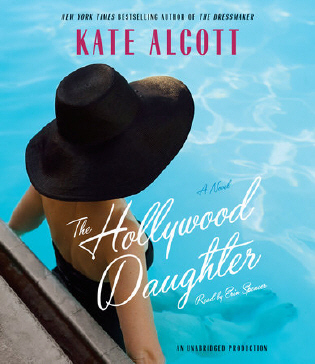
Friday Book Whimsy: The Hollywood Daughter

Author Kate Alcott tells a beautiful story of mother and daughter relationships set against the glamour of 1950s Hollywood and the darkness of the McCarthy years in this interesting and intelligent novel, The Hollywood Daughter.

I’m kind of an easy date when it comes to stories about Hollywood, much as I try to act like a grown-up reader. Last year I read All the Stars in the Heavens by Adriana Trigiani, which is a novel about the love affairs between Loretta Young and Clark Gable. I ate it up like an ice cream cone on a hot day. So when I came across The Hollywood Daughter, it was a given that I would read this novel that ties closely to Hollywood legend Ingrid Bergman’s controversial relationship with Roberto Rossellini. Controversial at the time, that is. Nowadays it would be quite a ho-hum relationship.

Jessica Malloy is a young girl at the beginning of the novel, the daughter of a Hollywood publicist for actress Ingrid Bergman. Jessica’s mother is distant and apparently clinically depressed, since she spends much of the novel in bed. In the absence of her mother, Jessica feels a connection to Bergman, who appears to have it all going for her. The connection isn’t just something Jessica dreams of; in fact, because she goes to a fancy-dancy school in Beverly Hills and Bergman’s daughter is on the carpool list, and because Jessica’s father is Bergman’s publicist, Jessica actually gets to know the actress.

Years go by and Bergman disappoints her devoted fans by falling in love with Rossellini, getting pregnant with his child, divorcing her husband and moving to Italy. At the same time, Senator McCarthy’s hearings begin and everyone is looking at everyone else, wondering just who are the bad guys. The atmosphere directly impacts Jessica’s father and their family dynamics.

It was fun to get some historical perspective of the times through the eyes of Jessica, from a small girl up until young adulthood. The background about Bergman was interesting, especially given just how the times compare to today’s Hollywood goings-on.

The Hollywood Daughter was a fun read and an interesting historical perspective.

Here is a link to the book.

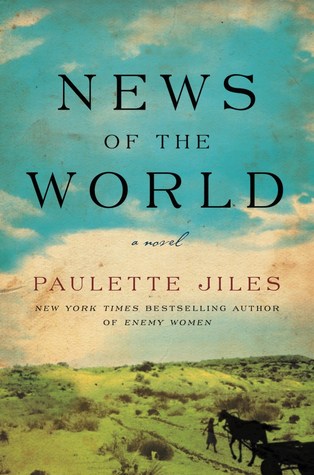
Friday Book Whimsy: News of the World

For reasons I can’t quite explain, I am drawn to novels that take place in the Old West of the 1800s. I like to imagine what it was like to live in the days before electricity, iPads, Snapchat, and nightly news.

News of the World, by Paulette Jiles, had an interesting premise. The protagonist, Captain Jefferson Kyle Kidd, served in – and was greatly impacted by – the Civil War. Now, however, he is just an elderly man who makes his money by traveling around northern Texas reading the news to people willing to give a dime or so to learn what’s happening in the world and who can’t read it for themselves. His wife is long dead, and his two daughters live far away. Still, while he’s a loner, he is satisfied with his life.

One day, he is offered a $50 in gold by the United States Army to return a 10-year-old orphan girl to her family in southern Texas. The child’s parents had been killed four years earlier by Kiowa Indians, who for unexplained reasons, took the child and raised her in the Kiowa tradition. The Army rescued her, and despite the fact that she was perfectly content in her new life, decided she needs to be returned to a distant aunt and uncle in San Antonio.

Thus begins a 400-mile journey by an elderly man and a little girl who speaks only the Kiowa language. She is terrified at the beginning, but eventually senses the man’s gentle nature and eventually comes to call him Keh-Pun, the Kiowan word for grandfather. He, in turn, tries to teach her English so that she will be able to communicate with the family she doesn’t know.

While the duo has several adventures along the way south, the book turns out to not be a story about cowboys and Indians; instead, it is a story about love and kindness. The pace is slow, sort of matching the pace of the pair as they make their journey. There are funny scenes as the little girl Johannah tries to learn the ways of the white people.

The twist comes when Captain Kidd and Johannah finally reach San Antonio, only to find a couple who is interested only in using Johannah as an indentured servant. Captain Kidd makes a decision that changes his life, and the little girl’s, forever.

As I mentioned, this is not an action novel, but a novel about relationships, trust, and love. I enjoyed the book, though I found the pace a bit slow at times. Still, it is a very short book, just this side of a novella.

Here is a link to the book.

Friday Book Whimsy: The Opposite of Woe: My Life in Beer and Politics

I struggle a bit with memoirs. Unless one’s life is really interesting or they became famous for doing something really interesting, I kind of think they are self-indulging. Because of this feeling, I am very picky about choosing a memoir in which to invest several hours of my life.

Having said that, I will tell you that I was interested in The Opposite of Woe: My Life in Beer and Politics by Colorado Governor John Hickenlooper for several reasons. The first, of course, is that he is the governor of Colorado, and I live in Colorado. The second is that in my past life when I was paid actual cash to write, I had occasion to meet the governor, though at that time he wasn’t the governor, but the Denver mayor. The third reason is that I knew that in his earlier life, Gov. Hickenlooper had lived in Maine, and had, at that time, been acquainted and associated with Bill’s kids’ uncle, who also lived in Maine. I had heard through the grapevine that their Uncle Bob was featured fairly significantly in the memoir.

What I found was a relatively well-written account of a pretty unusual and interesting life. The governor, like many of us, couldn’t quite find his niche in life. Impacted by the death of his father at a very early age, and then death of his stepfather unusually early as well, Hickenlooper did a bit of this and a bit of that before he started a brewery/restaurant in Denver and had a significant impact on the development of the city. And, by the way, he learned to brew beer from Uncle Bob, who thereby earned a spot in the book.

Unfortunately, the book had some of the problems I often see in memoirs: too much information. I frankly did a lot of skimming. The saving grace is that some of what felt like pretension was modified by a self-deprecating sense of humor.

I can’t say I would recommend this book to anyone who isn’t interested in Hickenlooper himself. But if you’re a fan, you might find some of his life background interesting.

Here is a link to the book.