Friday Book Whimsy: Since We Fell

Author Dennis Lehane is a good story teller, particularly when it comes to character development. A number of his books have been made into movies – Shutter Island and Mystic River, both dark and interesting films. Since We Fell will likely be no exception. It seems to have been written to be made into a movie.

Like many of Lehane’s central characters, Since We Fell’s protagonist Rachel Childs stayed with me long after I finished the book. She wasn’t exactly likeable, but she felt real to me and though I couldn’t quite relate to the dark side of her personality, the fact that she was multifaceted instead of one-dimensional was a plus.

Childs’ never knew her father, and her mother wouldn’t tell her who it was. Her mother had long ago written a book about parenting that apparently earned her enough money to live on the rest of her life. And yet, she was probably one of the worst parents I’ve ever come across in a novel. She was selfish and manipulative and gave Rachel an entirely unstable childhood.

The book is written almost like two separate novels. Rachel (who is a television journalist) spends the first half of the book trying to find her father. She is determined to find the man who her mother refuses to identify despite Rachel’s never-ending pleas.

Rachel teeters on the edge of unstability, and after visiting Haiti in her role as a journalist, and witnessing poverty and violence like she’s never seen, she has an on-air breakdown, is subsequently fired, and spends the next few years not leaving her home. Her husband, himself a self-serving TV journalist, divorces her.

She eventually reconnects with a man who has made brief appearances throughout the book, and responds to his kindness. They marry.

Then the book gets complicated and Part 2 begins. I know. I know. Part 1 seems complicated enough!

I won’t go into a lot of detail about the second part of the book, but it becomes a thriller that deals with trust and greed and who one can love. Part 2 finally clarifies why the first line of the book is “On a Tuesday in May, in her thirty-fifth year, Rachel shot her husband dead.”

In looking at reviews, opinions range from I couldn’t put this book down to this convoluted story made for one of the worst books I’ve ever read. I fall somewhere in between, but lean to the can’t-put-the-book-down side.

It’s true that much of the story is convoluted and demands that the reader suspend reality, but I just kept coming back to the characters. They were just so danged interesting.

A review of this book is difficult to write without giving away the surprises, and the twists and turns are critical. So you’ll just have to read Since We Fell yourself and see what you think.

Here is a link to the book.

Friday Book Whimsy: Magpie Murders

Magpie Murders, by author Anthony Horowitz, is a refreshing break from many mystery novels with predictable plots and authors that try just a bit too hard to give the reader a surprise ending. Horowitz is the creator and writer of one of my favorite British television crime dramas Foyle’s War, so I was very excited to see what he had up his sleeve with the unusual format of this novel.

Magpie Murders actually gives the readers two separate mysteries to ponder – a mystery within a mystery, so to speak.

Editor Susan Ryeland is given a copy of the manuscript of author Alan Conway’s latest novel featuring his famed detective Atticus Pund. Pund is very much like Agatha Christie’s famed detective Hercule Poirot, spending his time solving mysteries in little English villages, providing his readers with hints and red herrings galore. Since Ryeland has been Conway’s editor from the get-go, she is used to his formula; however, the more she reads, the more she thinks Conway is giving the reader a mystery within a mystery.

She continues to read, but just as Pund is getting ready to gather the suspects together to identify the killer, the story stops. Whaaaaat? The last chapter is missing. Why did Alan Conway not finish the book, but turn it in to his editor anyway shortly before he commits suicide?

Despite being ordered by her boss to leave it well enough alone, Ryeland begins trying to figure out why Conway would end the story in this manner. As you follow along with Ryeland, can you figure out what’s going on?

What I liked best about this book is that in the first chapter, Ryeland sits down with a cup of tea and hours of time and begins to read the manuscript. And then the book is presented to the readers of Magpie Murders just as Ryeland is reading it. And the Pund novel is a fun romp, very reminiscent of Agatha Christie. Manor houses, murders, mysterious guests. If that had been the entire book, I would still be giving it a good review.

But it isn’t. Because suddenly, the book ends, and the second mystery begins. It was so much fun (if you can call murder and suicide fun).

This really is a must-read for lovers of good mysteries with challenging endings, and definitely a must-read for Agatha Christie fans. As for me, I’m on the lookout for other books by this author.

Here is a link to the book.

Friday Book Whimsy: Hillbilly Elegy: A Memoir of a Family and Culture in Crisis

I’m not a big fan of nonfiction unless it is a topic about which I have a great interest. Life in the hills of Appalachia is a topic I find entirely compelling. It’s why I am such a fan of fiction – particularly mysteries – that take place in the area designated Appalachia.

Hillbilly Elegy, a memoir written by J.D. Vance, therefore captured my attention despite it being a memoir. I very often find memoirs self-serving and uninteresting. Hillbilly Elegy caught my attention from the get-go, and kept it throughout the book. Well, almost. Even the most interesting memoirs can get tedious when the author is talking about certain points in his or her life.

Mr. Vance is a former Marine who graduated from Yale Law School despite his difficult childhood. He uses the word hillbilly, a term with which I find myself somewhat uncomfortable, despite the fact that I occasionally use it to deprecate myself as part of my humor. I guess that’s why its serious use makes me squirm a bit. Still, he uses it to describe himself and his family.

Vance’s grandparents moved from Kentucky to Ohio when they were newly married. According to the author, a large number of Scotch/Irish Appalachians moved to the so-called Rust Belt following World War II in search of a better life where jobs were plentiful in the mining and manufacturing region. Unfortunately, the poverty, drug abuse, alcoholism, violence, and general dysfunction followed the immigrants. You can take the man (or woman) out of the violence but you can’t take……

The book is not really so much about so-called hillbillies as it is about white working class Americans and how our system has failed them. Vance was mostly parented by his grandmother and grandfather, who were not unblemished themselves, but at least were a constant in his life. His parents were unavailable to him. His mother, in particular, failed him because of ongoing drug addiction. Aunts, uncles, cousins all demonstrated violent behavior and depended on drugs and alcohol to get through their difficult days.

There has been much talk lately about the problem of drug abuse as well as how poorly working class Americans are faring, but Vance’s perspective is different from many as this was his real life, the background from which he came. Drug and alcohol abuse, and general violence, were part of his roots. He credits his grandparents for his success.

Vance’s talk about government’s failings might be anathema to some who believe government assistance is the best way to help fight poverty. But he makes so many good points that I found myself highlighting section after section of my book. And then, unfortunately, returning it to the library.

A very interesting read indeed.

Here is a link to the book.

Friday Book Whimsy: Cocoa Beach

What comes first, the chicken or the egg? That was the question I asked myself as I read Cocoa Beach, the latest novel from Beatriz Williams.

As with many of the author’s novels, the story is connected in some way to characters in another of her books. It took me a bit to realize that the main character of Cocoa Beach was the sister of one of the main characters in A Certain Age, a novel that I read and liked very much, despite a slow start. As I read this latest book, I found myself wondering if the author wrote these two books in the wrong order, as Cocoa Beach is somewhat of a prequel.

The novel tells the back story of Virginia Fortescue, the sister of Sophie Fortescue of A Certain Age fame. Cocoa Beach is a mystery novel from the get-go. In fact, the very first chapter is an incriminating letter from the man who will become Virginia’s husband, setting the stage for what might have been a really interesting story.

Except that it wasn’t. Instead, it was a confusing back-and-forth story about Virginia during World War I where she works as a driver and first meets Simon and then about Virginia a few years later in the Roaring 20s when she is trying to figure out who is trying to kill her, and why. Is it her husband? Is it his brother? Most of the time I just found myself trying to figure out what year it was and who was doing what. I found it to be most confusing.

The location was new and different for the author. While many of her novels take place in New York City, Cocoa Beach took place in, well, Cocoa Beach, Florida, as well as Miami, Florida.

As Virginia tries to figure out what is going on, she keeps hearing about what is happening back home in New York with her sister Sophie and her father, accused of killing her mother (part of the plot of A Certain Age). It added to the muddle and confusion of the novel.

I must say that the author kept us wondering until the very end just who were the good guys and who were the bad guys. But Williams pulled a trick that I simply loathe: at the very end of the novel, something happens that ensures that there will be a sequel. It frankly was so badly written that I sat and stared at the book for some time, wondering if I had missed something.

I simply didn’t care for this book. I found it entirely too confusing and silly. That’s a hard pill for me to swallow from an author whom I like so much.

Thumbs down on this one.

Here is a link to the book.


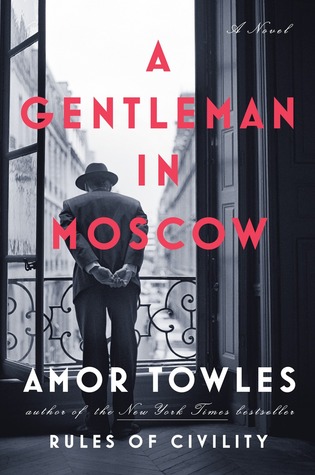
Friday Book Whimsy: A Gentleman in Moscow

Since its publication in 2016, and into 2017, A Gentleman in Moscow, by Amor Towles, kept coming up as a book I MUST read. The best book of 2016, they said. One reviewer said A Gentleman in Moscow was her best book EVER.

After a long wait at the library, I finally got the book, and dove in. It’s not that I was disappointed; I just was a bit underwhelmed. Don’t hate me All of You Book Reviewers Who Loved This Novel. Just recognize that I’m not nearly as sophisticated as you.

Towles wrote a book called Rules of Civility published back in 2011. I read that book and liked it, but recall that it took me a very long time to get into the story. So when I found myself having trouble getting into this novel, I didn’t get discouraged. It helped that Towles’ writing is truly beautiful and elegant. It fit the story perfectly.

A Gentleman in Moscow tells the story of Count Alexander Rostov, a Russian aristocrat from a long line of Russian aristocrats. The story begins in 1922, when Count Rostov is tried by a Bolshevik court for being an aristocrat. Communism, you see. He is placed under house arrest at the Metropol Hotel, a real-life historic hotel in Moscow. He must live out the rest of his days within the confines of this elegant hotel. He has pretty much the run of the hotel. He can eat in the dining room; he can get his hair cut at the fancy barber; he can drink cognac at the bar. He just can’t leave the hotel.

The years pass, and the count has a series of relationships that are funny and poignant and interesting. Of particular note is a close friendship he develops with a young girl who lives with her parents in the same hotel. She provides him with not only friendship, but with a quirky outlook that is welcome given the fact that he can’t even go outdoors.

The book is really a series of vignettes. The writing, as I stated above, is eloquent, and fits nicely with the beautiful art deco hotel and the roaring twenties. The book follows the count throughout the next few decades into the 1950s and the Cold War.

Really, nothing much happens. Perhaps I was just at a time in my life when I needed a bit more action. I really did like the author’s writing, and Count Rostov was a likeable character, but I simply found myself skimming a lot of the chapters. I also found myself wondering if the leaders of the Communist party, particularly that close to the overthrow and murder of Tsar Nicholas II and his family, would really have allowed an aristocrat like Count Rostov to live such an unfettered life. It just didn’t seem realistic to me.

I’m definitely in the minority, at least when it comes to the reviews I’ve read. The book has been highly regarded.

Recommended for those interested in beautiful writing and less interested in a fast-paced story.

Here is a link to the book.

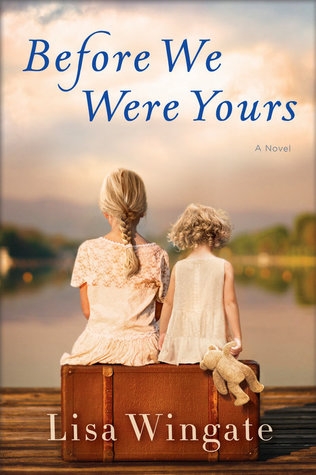
Friday Book Whimsy: Before We Were Yours

The plot of Before We Were Yours, by Lisa Wingate, is so startling that it is hard to believe it is based on fact. So startling, in fact, that this reader kept going back to Wikipedia to confirm that the practice talked about in this excellent novel actually took place.

In the manner of many novels written today, the story comes from two viewpoints.

The first viewpoint is that of Rill Foss. It’s 1939, and Rill and her four younger sisters live with their parents on a riverboat outside of Memphis, Tennessee. They are dirt poor, but are a very happy family. One night, Rill’s mother goes into labor, and it isn’t long before they realize that the birth won’t be an easy one and can’t be handled by the local midwife. Rill’s father leaves her in charge while he takes his wife into the hospital in town.

A day or so later, a group of people claiming to have authority to do so come aboard the riverboat and take custody of the kids. The five girls are taken to an orphanage. They are told that their mother and the baby have died and that their father is too distraught to care for them.

The second story line takes place in contemporary time, and features Avery Stafford. Avery is the daughter of a South Carolina Congressman who is running for reelection. Avery works for her father, and is, in fact, being groomed to succeed him. While visiting a nursing home, Avery notices that a resident named May Crandall is wearing a bracelet just like one owned by her grandmother. She wants to find out if there is a link, but unfortunately her grandmother has Alzheimer’s disease.

In the way of many novels, Avery can’t let this go, despite her family’s encouragement to do so. And she eventually uncovers a truth about her family that will change her life.

Here is the part of the novel that is unbelievably and unfortunately true. The orphanage was, in fact, a place where people with enough money could buy a child. The woman who ran the orphanage was named Gloria Tann, and her adoption organization kidnapped mostly poor children and sold them from the 1920s until the government finally began looking into it in the 1950s. Tann died of cancer before the investigation became public.

While the subject matter is excruciatingly sad, Wingate’s writing is lovely and lyrical and makes the novel easy to read and not a tearjerker. The story is interesting, and while the ending was somewhat predictable, it made me happy nonetheless.

I enthusiastically recommend this novel.

Here is a link to the book.

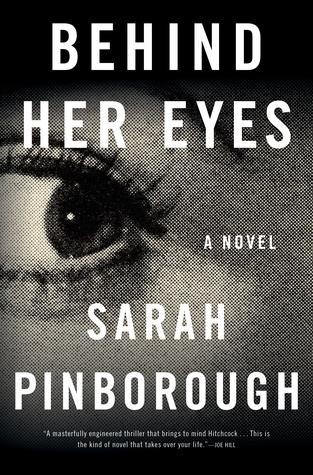
Friday Book Whimsy: Behind Her Eyes

In the past few years, I’ve become a fan of the so-called psychological thriller. Like the thousands and thousands of readers who, like me, got hooked on The Girl on the Train and Gone Girl, I’ve read a number of books of this genre, trying desperately to find a worthy follow-up. Unfortunately, I’ve mostly been disappointed. For example, Girl on the Train’s author Paula Hawkins’ second novel, Into the Water, was a great disappointment.

Still, I forged on, and found myself reading Behind Her Eyes, by Sarah Pinborough. The book was described as an eerie thriller with an ending that would surprise and shock the reader. It seemed like a safe bet. I like a good ending. Gone Girl had a good ending. When I finished that novel, I literally through the book across the room in frustration. But it was a good frustration.

When I finished Behind Her Eyes, I didn’t throw the book across the room because these days I read on my iPad, but I wanted to. Unfortunately, not because of a good frustration, but because of my disappointment that I had spent so much time on the book and the ending was so incredibly STUPID.

Don’t get me wrong. I found much of the book to be a good yarn with thought-provoking characters. Sure, at times I had to suspend belief because of the unlikeliness of what was transpiring. But the characters, while not particularly likeable, were interesting.

Louise is a single mom, stuck in a boring office job. One night she goes out for a drink after work. She meets an good-looking man whom she finds interesting and easy to talk to. This leads to that, and they share a passionate kiss and he leaves. She expects to never see him again, but lo, and behold, it turns out that he is her new boss, something she learns the next day when she goes to work. Oh-oh.

Oh-oh, because he has photos of his gorgeous wife sitting on his desk. What’s more, he still can’t seem to keep his eyes off of Louise. Louise vows to herself to make certain nothing untoward happens, but accidentally befriends his wife. Belief-suspension kicked in, because this reader can’t even begin to understand how this happened, despite the author’s efforts to explain.

It isn’t long before Louise realizes that something is amiss in the marriage, but she can’t figure out who’s at fault. David (the boss) appears to be controlling and Adele (the wife) appears to be frightened of her husband. As for David, he continues to appear to be the kind of man who is sweet and loving. Louise spends most of the novel trying to figure out what’s happening.

It isn’t badly written. In fact, I enjoyed most of the novel. The conclusion, however, was so ridiculous (at least in this reader’s view) that I simply can’t recommend the book. It became clear as to why Behind Her Eyes got such mixed reviews from other readers.

So, read the book at your own risk!

Here is a link to the book.


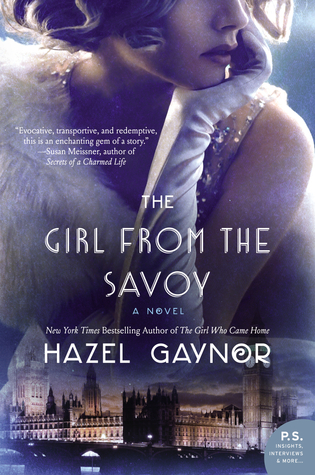
Friday Book Whimsy: The Girl From the Savoy

Having spent the past couple of years slogging my way through World War II historical novels, I have become somewhat addicted to stories that take place in a much more hopeful era – the Roaring Twenties. True, there were those poor souls returning from fighting in the horrific First World War, but in the 1920s, people were optimistic that things would be better and that they would be able to find alcohol even in the midst of temperance.

The Girl from The Savoy, a novel written by the prolific author Hazel Gaynor, tells the story of one young woman who was darkly impacted by World War I, but faces the future with great hope and spirit.

Dolly Lane, a talented dancer, has always dreamed of being in show business. Her dream conflicted with her love for hometown boyfriend Teddy, who is a victim of World War I. Through the help of a friend, Dolly gets a job as a housekeeper at London’s famed Savoy Hotel, where she hopes to become recognized by some of the famous show business people who live there.

She has a chance encounter with a young businessman as she rushes to work on the first day, and can’t begin to imagine how that encounter will impact her life. It isn’t long before Dolly answers an unusual ad to be a muse to a young songwriter. Through this position, she meets and becomes friends with well-known actress Loretta May, who will change Dolly’s life. But Loretta has her own sad secret. Wars have a way of affecting everyone in some way or the other.

Though Dolly is the star of the show, the novel is told in three separate voices. The author does a great job of keeping the voices unique but consistent, thereby eliminating confusion. It isn’t long before Dolly faces some difficult choices which will pave the way for the rest of her life.

The author is recognized as a romance writer, but the novel is not sappy-sweet and the characters are likeable. I love the descriptions of The Savoy Hotel, almost feeling its elegance. The ending is satisfying if somewhat predictable.

Here is a link to the book.

Friday Book Whimsy: Snow Flower and the Secret Fan

I’ll be perfectly honest. I mostly avoid reading books by Chinese authors if the stories are about life in China. I’m not anti-China; I just feel like the stories always move so slowly. So I wouldn’t have picked up Snow Flower and the Secret Fan, by Lisa See, had it not been recommended by someone whose reading opinions I trust.

Though it wasn’t particularly a page-turner, I enjoyed the book and learned an incredible amount – much of it quite disturbing – about life in 19th and 20th Century China. Particularly life for women.

Snow Flower and the Secret Fan takes place in a small village in 19th Century China, and tells the story of two friends – Lily and Snow Flower – and their incredibly difficult lives. They are more than just friends. They are laotong – or “old sames,” committed to each other for their entire lives.

The story is told from the perspective of Lily, now in her 80s. She tells not only the story of their friendship, but the story of the amazingly difficult lives led by the women in China during this time.  Girls were literally distained by their parents from birth on. The birth of a girl baby was a grave disappointment to both the mother and the father. The only purpose girls had was to work and take care of the family. Once a girl married, they moved to their husband’s house and took care of his family.

The most interesting – if disturbing – part of the book were the graphic details about foot binding, and the part it played in girls’ lives. It resulted in me looking into the practice in great detail with shear horror. Imagine having your foot broken over and over again, until it is a perfect four inches long. The women literally couldn’t walk.

But the story about the secret language and the writings that only women could understand were beautiful and quite interesting.

The writing is lovely, and it you don’t mind a rather slow read, this novel might be just for you.

Here is a link to the book.

Friday Book Whimsy: Kiss Carlo

Novels by author Adriana Trigiani are always eagerly anticipated by this reader. I’ve been reading this prolific novelist’s works since the very beginning, with her Big Stone Gap novels. I loved the four Big Stone Gap novels because they had two things going for them  — they took place in Appalachia and they are about an Italian family.

I’m not Italian, but I think I was in a previous life.

Having said all of the above, I have been very disappointed in her last few novels. The Valentine series wore thin, with The Supreme Macaroni Company falling flat on its face. I found All of the Stars in Heaven to have an interesting premise, but was somewhat disappointed at the writing.

Still, as soon as Kiss Carlo was released, I read the book. With great gladness, I liked everything about it. Everything perhaps, except for the title, which never quite made sense to me. Nevertheless, I loved this book.

The story takes place following World War II, when south Philadelphia – along with the rest of the United States – was booming. The men were back from fighting, the GI bill and VA loans were making education and home ownership possible. Nicky Castone is sharing in the glory.

Nicky was left an orphan by the death of his mother and father when he was just a young boy. He was taken in and lovingly cared for by his aunt and uncle, who own a thriving cab/telegraph company in south Philly. Nicky drives one of the cabs, but secretly dreams of being an actor. He volunteers his time as a reader at a dying Shakespearean theater nearby. The theater is run by the beautiful and spirited Calla Borelli.

Nicky soon finds that these dreams are important enough that he moves away from the nest to New York City to become and actor in the early days of television. Will Nicky find his dream? Will the dream change him?

The novel is an amusing romp, and despite the fact that there are a lot of quotes from Shakespeare and some of the story lines parallel Shakespeare’s plays, the book is just plain fun. (Not that Shakespeare isn’t, mind you!) The dialogue is quick and clever and reminded of me of being around Italians during our visit to Europe in 2008. The conversations strike me as realistic and honest.

I recommend the novel.

Here is a link to the book.