I’ve mentioned two or three thousand times that my paternal grandparents came to the United States from Switzerland in 1924. I never asked them directly why they did so, but I imagine the economy had been impacted by World War I, and perhaps they even saw the handwriting on the wall regarding another imminent war. Ask your parents and grandparents question now, Kids. It will soon be too late.

This is the actual ship upon which my grandparents sailed from Bremen to NYC in 1924.
As you know if you paid attention during World Geography, Switzerland is a small country bordered by Germany, Austria, Italy, and France. The language spoken by the Swiss people depends upon the nearest border country. In other words, some people speak French and some speak Italian. But the majority of folks speak German, or at least a form of German. My understanding is that the formal written language is German, but I can tell you from personal experience that the spoken language is a Swiss dialect form of German. I studied some German, but never was able to understand a word my grandparents spoke when they weren’t speaking English.
When my grandparents settled in Columbus, my grandfather – who now had his own business – immediately took lessons to learn to speak English. I don’t think he was required to do so; he just presumed that to successfully run the bakery, it would help to know the English language. He always spoke perfect English.
My grandmother, on the other hand, didn’t study to learn English. Now don’t get me wrong. She
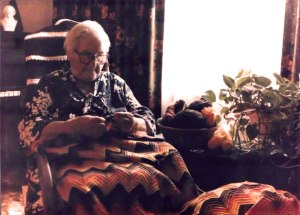 learned English. She just didn’t take formal lessons. She learned it by talking to people and working the front end of the bakery.
Imagine that. Imagine suddenly living in a place where you didn’t speak a word of the language. Bill and I struggled with language enough during our big adventure, and that was only for three months, and as tourists, we could get away with a lot. For Grammie and Grandpa, English was going to be the language they spoke for the rest of their life. I’ve always been amazed at how well they adjusted.
And especially my grandmother – learning the language without a single lesson. Now don’t get me wrong. She didn’t speak perfect English. But she spoke her version of English and it was certainly understandable by everyone. In fact, it was absolutely perfect to our ears.
If you have ever studied a foreign language, you probably know that there are certain words that you just don’t translate well. It might take five or six words to explain what a word means, and then it still doesn’t quite fit the bill.
Grammie had a lot of words like that. Dad picked them up, and so did Mom. In fact, we all learned what really was, for all intents and purposes, a secret language. Our spouses had to learn them, and our children have listened to them since birth.
Since most of them are either Swiss/German words, or a variation of such, I am not certain how they would be spelled. Many likely would require an umlaut, which is a symbol placed over a vowel indicating a slight variation in the sound. My keyboard doesn’t include the umlaut, and most would have trouble pronouncing it anyhow. You just have to work with me here.
I will give the word, spelling it the best I can, give as much of a definition as I can, and then use it in a sentence.
So:
Fuscht — mess around with, as in “Will you quit fuschting with your hair.”
Blurt — stupid, silly, as in “The TV show Nashville is becoming very blurt.”
Honyock (pronounced hun-yock) — little stinker, as in “Austin Joseph Jensen is a honyock.”
Bundy — a group of people who are a handful (important distinction). So, this word requires a bit of explanation. Here’s what I mean: The congregation at my church would not be called a bundy. However, there is a family that comes to church every Sunday. They take up the whole pew. The family consists of a couple of Grandmas and Grandpas, some grown children and their spouses, and some grandchildren. The grandchildren are constantly crawling back and forth on the pew, going from one grandma to another. During the handshake of peace, everyone has to hug everyone else, and it causes quite a disruption. This family is a bundy.
Frufra — backside, as in “She fell down and landed on her frufra.”
Rappsli — grating, as in “I am going to rappsli some Swiss cheese.”
Schmutzig – this, of course, is an actual German word, meaning dirty, as in “How could you have gotten your clothes so schmutzig in such a short time?
Klotch – hit, as in, “I just got klotched in the head.” In fact, I think klotching was always in the head. I don’t think one got klotched in the stomach, for example.
Knible – rolling pin, and mostly the ones without the handles.
Schweinhunt – this is another actual German word, literally translated as pig-dog. In German, it is highly offensive. In our case, it was almost an affectionate rebuke that meant you were being naughty. My brother said he was often called a schweinhunt.
Kaput – another German word meaning end. For us, it meant a final end, and generally of a piece of machinery, a car, or something that was totally and finally broken.
Boobly – this was Grammie’s word for the little topknot made out of yarn that she put on every single hat she ever knitted or crocheted for us. People frequently wear hats with booblies. For example, the NFL football players this past year all wore stocking caps with booblies. However, something tells me Peyton Manning didn’t refer to his topknot as a bloobly. It was.
Schnabel – Well, I’m not going to translate this one for you. Use your imagination.
While we have all picked up the words as a natural part of our vocabulary, it is interesting to note that it doesn’t seem like our children have. Perhaps we don’t use the words as often as our parents and grandparents did. Or maybe our kids just prefer to use words that are actually in the Webster Dictionary. Still, it makes me kind of sad to see these words pass into obscurity.
The title of my post, by the way, comes from something my grandmother used to say when someone would come to visit her at her home. I’m not sure she ever knew her error, and no one seemed to have their feelings hurt.
Do you have any family words that you use?
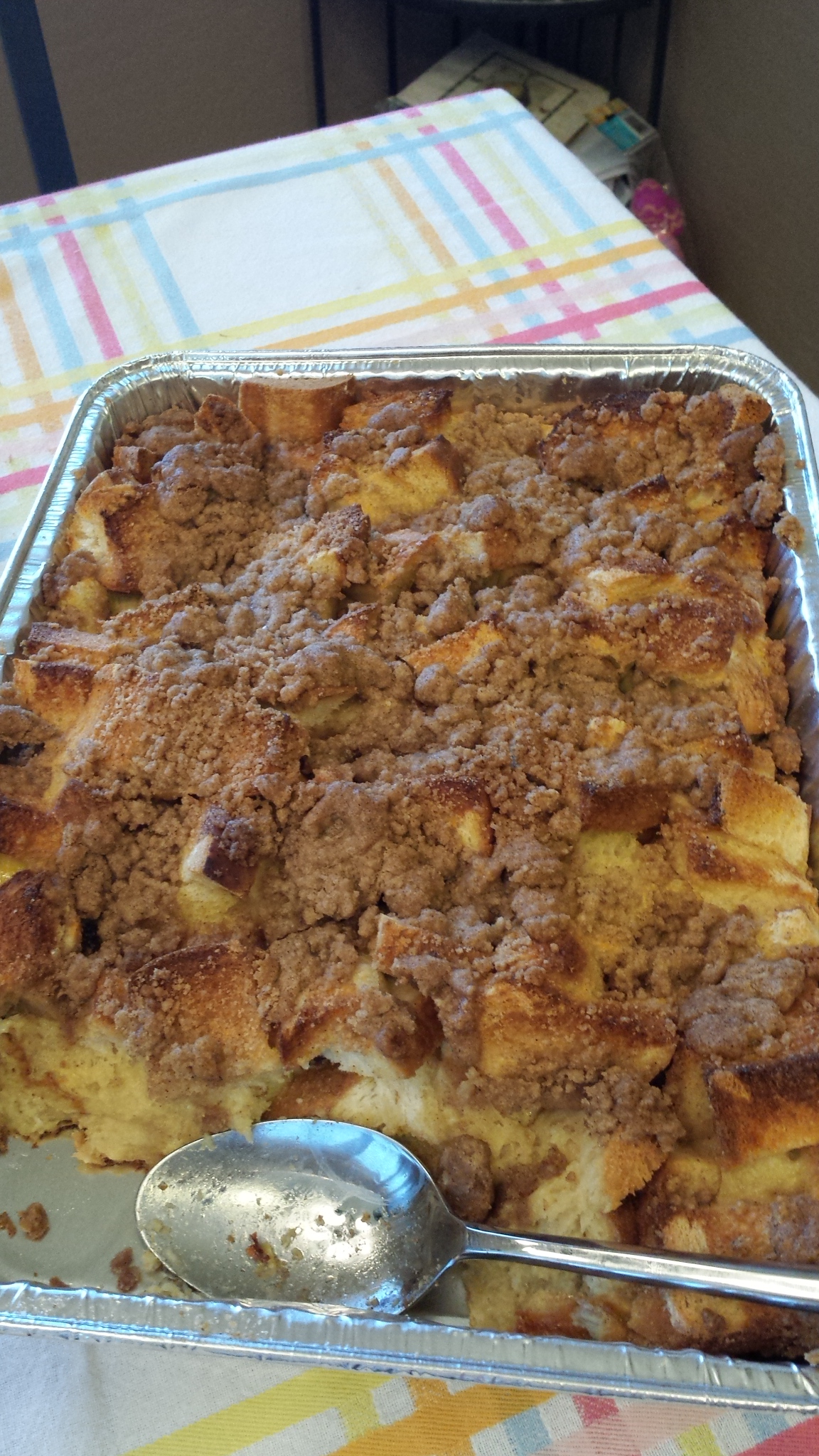
In yesterday’s post, I mentioned a delicious French toast casserole that I made for Easter brunch, and someone asked for the recipe. I am happy to provide it, and highly recommend you try it when you have calories to spare.
 Baked French Toast, courtesy Ree Drummond, The Prairie Woman, and Food Network
Ingredients
Butter, for greasing
1 loaf crusty sourdough or French bread
8 whole eggs
2 c. whole milk
½ heavy cream
½ c. white sugar
½ c. brown sugar
2 T. vanilla extract
Topping
½ c. flour
½ c. firmly packed brown sugar
1 t. cinnamon
¼ t. salt
Freshly grated nutmeg (optional)
1 stick cold butter, cut into pieces
Process
For the French toast: Tear the bread into chunks, or cut into cubes, and evenly distribute in the pan. Crack the eggs in a big bowl. Whisk together the eggs, milk, cream, white sugar, brown sugar and vanilla. Pour evenly over the bread. Cover the pan tightly and store in the fridge until needed (overnight preferably). Or you can make it and bake it right away.
For the topping: Mix the flour, brown sugar, cinnamon, salt and some nutmeg in a separate bowl. Stir together using a fork. Add the butter and with a pastry cutter, mix it all together until the mixture resembles fine pebbles. Store in the fridge.
When you’re ready to bake the casserole, preheat the oven to 350 degrees. Remove the casserole from the fridge and sprinkle the topping over the top. Bake for 45 min. for a softer, more bread pudding texture or for 1 hour-plus for a firmer, crispier texture.
Serve with butter, syrup and berries.
Nana’s Notes: This casserole is decadent. It is the best baked French toast I have eaten. I served it with real maple syrup. We reheated leftovers yesterday, and I think it might even be better the second day.

 By Rebecca Borman










 Nana's Whimsies