Friday Book Whimsy: Come Rain or Come Shine

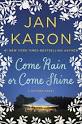
searchPotentially, this could be the shortest book review ever. All I REALLY would have to say is that there is a new Mitford book by author Jan Karon entitled Come Rain or Come Shine. Boom. Everyone can correctly assume that I loved the book.

The fictional town of Mitford, North Carolina, makes me happy. I am fully aware that such a wonderful community where everyone gets along and loves one another doesn’t exist. Still, isn’t it so nice to read about something like the friendly folks of Mitford instead of about pain, and murder, and bickering, and poverty, and the horrors of the real world, especially during this time of the year?

In Come Rain or Come Shine, Dooley – who we met in Karon’s first Mitford novel At Home in Mitford – has graduated from veterinarian’s school, set up a practice and is finally getting married to his long-time girlfriend Lace (who we also met in the first novel). Typical for the young couple, they want to make their wedding simple and inexpensive, and to include all of the people they love. They decide, then, to make it a pot luck affair to be held at the ranch where they will reside after they are married.

Since nothing ever goes entirely as planned in Mitford (or in real life), the novel offers a series of surprises and unexpected joys. While Dooley and Lace have to be flexible with their plans and the wedding doesn’t go as smoothly as one would hope, Karon’s story gives us a full picture of love – the love of friends and the love for and of God. The amazing and vivid trust that the people of this town have in God’s provides for a joyful read.

And let’s not forget the wonderful food that is always a part of Mitford – and Karon’s wonderful stories.

Come Rain or Come Shine was written a bit differently than Karon’s previous novels. The point of view changed with each chapter. Being an avid Mitford fan, I was able to recognize whose point of view was being presented in each chapter. However, I would think that if someone picked up the novel without having read Karon’s previous works, it might have taken some time to recognize the point of view. If I have any criticism, that is it.

One of the best parts of the novel, I felt, was getting to know Lace a bit better. While she has been part of the Mitford series from the beginning, she has never played a major role. I enjoyed learning more about who she is and how she thinks.

This is a grand book for someone wanting to read a happy story during this time of year. I strongly recommend it.

Here is a link to the book.

unnamed

Friday Book Whimsy: Girl Waits With Gun

searchOne day in 1914, three young women – Constance, Norma, (both 30-something) and Fleurette (16) Kopp are riding in their horse-drawn buggy to their farm from the nearby New Jersey town in which they had been shopping, and are slammed into by an automobile. The car’s driver is the rich, alcoholic, and ill-mannered proprietor of the silk manufacturer that employs many of the townspeople.

Thus begins author Amy Stewart’s first novel, Girl Waits With Gun. While it is admittedly a novel, it is largely based on a true story about the ensuing troubles after Constance – a very tall and intimidating woman – becomes obsessed with getting the money owed for the damage from Henry Kaufman. Her efforts bring her in contact with – and eventually lead her to provide considerable help to – the local sheriff. Constance Kopp goes on to become one of the nation’s first female deputy sheriffs.

While the premise perhaps sounds dull, the novel is actually interesting and fun to read. The Kopp threesome are enormously entertaining, just as I suspect they were in real life.

While the three women – both in the novel and apparently in real life – present themselves as sisters, the reader learns early on that Fleurette is actually Constance’s daughter. This fact is unbeknownst to Fleurette herself, and only marginally meaningful to the story told in Girl Waits With Gun.

There are actually two stories that run parallel. The first is based on fact – that of the accident and the events that followed. The second, related, tells the story of a young woman who had been employed at the silk factory and got taken advantage of by Henry Kaufman, who subsequently takes away the child she bears.

The book is a fairly quick read, and provided a lot of entertainment. It’s fun to see how something we so take for granted today (women in law enforcement) was actually the result of a hard-fought battle.

Great book for a book club discussion.

Here is a link to the book.

unnamed

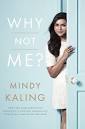
Friday Book Whimsy: Why Not Me?

searchI will tell you the truth right up front. I love Mindy Kaling. I am not her demographic. I am way older than what I would believe is her typical fan. But The Office, for which she wrote many episodes and appeared as Kelly Kapoor, made me laugh (until Steve Carrell left at which time it didn’t make me laugh any more). And I found her own show, The Mindy Project, to be quite quirky and funny in a just-short-of-offensive way. Admittedly, I don’t find it funny enough to pay money to watch it now on Hulu, which picked it up after it was cancelled by Fox.

Her first memoir, Is Everyone Hanging Out Without Me?, was humorous and provided the reader with a good sense of what it’s like to break into television, especially for a minority. Why Not Me? continues her personal story via short and very amusing essays.

The book – and Ms. Kaling – wouldn’t be for everyone. She doesn’t hold back from saying what she thinks. In fact, if you watched The Mindy Project, it appears you will have a pretty good idea of who Kaling is (though one of the essays in the book is about ways in which she is different from the character she plays on The Mindy Project – i.e. TV Mindy would sue a Boston Market for giving too-small helpings of sides, and TV Mindy would own a gun and keep misplacing it). Still, the irreverence seems to be the same.

While not particularly a fan of nonfiction, I am – oddly, perhaps – a fan of biographies and memoirs. Caveat, I simply loathe the self-indulgent oh-poor-me-I-grew-up-in-a-dysfunctional-family memoirs seemingly written by anyone who knows how to use a keyboard. I enjoy memoirs in which the writer doesn’t take himself or herself too seriously and can make me laugh, or has a truly interesting story to tell. Why Not Me? meets both criteria.

The book reads very quickly and I finished it in one day. It was a nice break from the serious books I had been reading as of late.

If memoirs are your cup of tea, give Why Not Me? a try.

Here is a link to the book.

unnamed

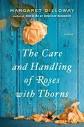
Friday Book Whimsy: The Care and Handling of Roses with Thorns

searchWhen we first bought our house , there was a rose garden in the back yard. I love roses. They are so beautiful, fragile and yet resilient, and the blossoms smell so good. But it took no more than a season or two for me to destroy each and every rose bush. They require a lot of tender, loving care.

I thought about my short-lived tenure as a rose gardener as I read The Care and Handling of Roses with Thorns by Margaret Dilloway. Growing roses is not for the timid gardener. It requires a lot of patience, and you have to not mind getting stuck by the thorns.

Galilee “Gal” Garner – the protagonist in The Care and Handling of Roses with Thorns, has spent much of her adult life tending to her roses. She is not just a rose gardener, but passionately pursues her hobby of breeding new hybrids with the ultimate goal of getting a new rose into the market. She earns her living as a high school biology teacher, but who she is was primarily shaped by the fact that she has been on kidney dialysis for most of her life. She has had – and rejected – several kidney transplants. As the novel takes place, she is awaiting a new kidney, and must spend every other night undergoing dialysis. At the same time, she is awaiting recognition for her roses. It’s an interesting dichotomy.

Because so much of her parents’ lives were spent handling Gal’s illness, Gal’s younger sister grew up using drugs and alcohol to garner attention. Her actions result in her teenaged daughter Riley coming to live with Gal for a period of time. The situation changes all of their lives.

Gal’s personality is prickly at best. And my use of the term prickly is no accident, as Dilloway is clearly urging us to compare roses to our heroine.  Thorny on the outside, but lovely when you look beyond the thorns.

The story develops slowly – perhaps a bit too slowly. Once you have the background (that is, learn a lot about kidney disease, dialysis, and roses), and more importantly upon the arrival of Riley, the storyline blossoms (sorry, no pun intended). I couldn’t put the book down.

Gal isn’t an easy character to like, and I think that’s the way Dilloway intended it. You know – roses with thorns. But she also isn’t an easy character to forget, especially once you get to know her. I enjoyed learning about roses. I now have a much clearer picture of what it’s like to depend on dialysis to live. I even understand the ups and downs of being a teacher.

The Care and Handling of Roses with Thorns is a lovely story, and I recommend you give it a read.

Here is a link to the book.

unnamed

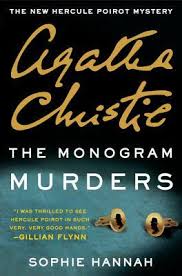
Friday Book Whimsy: Agatha Christie’s The Monogram Murders: The New Hercule Poirot Mystery

imgresThe newest thing seems to be authors taking over the writing of popular mystery series after the original author dies. Ace Atkins continued Robert B. Parker’s Spenser series. More recently author Kyle Mills continued the iconic Mitch Rapp series originated by the late Vince Flynn. It is my understanding that these authors have continued the series with the deceased author’s family’s permission.

I wasn’t aware, however, that there was a new Hercule Poirot book. SERIOUSLY?????

I was amused to find out very recently about Sophie Hannah’s new addition to mystery writer extraordinaire Agatha Christie’s Hercule Poirot series. The reason for my amusement was that it has been said that by the later books, Christie was sick and tired of the somewhat annoying little Belgian detective. She is to have said “he was a detestable, bombastic, tiresome, egocentric little creep.

But he was a detestable, bombastic, tiresome, egocentric little creep who I absolutely ADORED. As did many others. So I shouldn’t have been surprise to see this addition.

Since Christie famously killed off the detective in her final Poirot offering Curtain: Poirot’s Last Case, I wasn’t sure how Hannah was going to handle the new Poirot mystery. As it turns out, it is not subsequent to Curtain. Instead, it is just folded into his earlier life.

Hercule Poirot as portrayed by David Suchet in the wonderful PBS long-running series.

Hercule Poirot as portrayed by David Suchet in the wonderful PBS long-running series.

I was excited when I first began reading The Monogram Murders, though slightly apprehensive about another author besides Christie presenting Poirot, both in his appearance and actions, and by how the mystery would unfold. As much as I read mysteries, I admit I was rarely able to figure out the murderer in any of Christie’s books. Cheers to Dame Christie.

I started out optimistically, but I’m afraid I was soon disappointed. As hard as Hannah worked at presenting a reasonable imitation of the famous detective, it’s not surprising that she fell just short of success. Poirot did things in this book that he simply wouldn’t have done. It is hard to put my finger on what I mean, but if you are a fan of Poirot, you will understand. So then he was simply a detestable little creep.

Poirot has a new sidekick in this mystery, a Scotland Yard detective named Catchpool, and he is certainly no Arthur Hastings. I found him to be both unlikable and quite inept. It’s true Captain Hastings was not the brightest bulb on the Christmas tree, but you couldn’t help but like him. Poirot and Catchpool worked together to solve the mystery of the murder of three people from the same small English village who share a dastardly secret.

I found the ending particularly unsatisfactory. One of Christie’s many strengths was that she could wrap it all up so satisfactorily, and all of the clues she sneakily placed throughout the book suddenly made sense. Hannah was not successful in this effort. The ending was frankly, terrifically confusing and chaotic. I found myself skimming the last confusing chapters because by that point I didn’t care who killed whom.

I’m thinking this might be the last attempt at adding to Hercule Poirot’s legacy.

Here is a link to the book.

unnamed

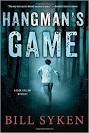
Friday Book Whimsy: Hangman’s Game: A Nick Gallow Mystery

searchAs much as I love mystery stories, I try to limit the number that I review. I avoid reviews of mysteries mostly because each book is often part of a series, and so I am reluctant to review only one of the books. I’m making an exception with Hangman’s Game primarily because it is a debut novel, though the fact that it is called A Nick Gallow Mystery leads me to assume that the author, Bill Syken, intends to make it a series.

I hope so.

Nick Gallow is a punter for the fictitious NFL team the Philadelphia Sentinels. He is a somewhat disgruntled punter. He was originally a college quarterback but was injured in a way that precluded him from continuing as a QB. At the urging and with the assistance of his football coach father, he reinvents himself as a punter, a role he has played for five years with the Sentinels.

One night, following dinner with his agent and the brand new and highly-paid Sentinels rookie, a drive-by shooting results in the rookie being killed and the agent being seriously injured. Gallow is the only witness, and he didn’t see a lot. All fingers are pointed at a self-absorbed and arrogant Sentinels linebacker as the killer, but Gallow doesn’t think so, and sets out to find out.

The author is a long-time sportswriter and editor with Sports Illustrated, and so his descriptions of the BUSINESS of football are believable. As an avid football fan, I enjoyed getting a pretty honest picture of what it’s like to be a punter – basically the low man on the totem pole that consists of plenty of prima donnas.

Reviewers have said that the reader doesn’t need to be a football fan to enjoy the book, but I’m not certain I entirely agree with this assessment. It is a very good mystery, but part of what I enjoyed about the book was the element surrounding professional football.

With that caveat, I recommend the novel, and look forward to the next Nick Gallow mystery.

Here is a link to the book.

unnamed

Friday Book Whimsy: The Rent Collector

imagesI was initially interested in reading The Rent Collector, by Camron Wright, because the story takes place in Cambodia. One of my daughters-in-law is Cambodian (born there and moved to the United States with her mother, father, and baby brother when she was a toddler during the latter days of the horrible-beyond-belief Khmer Rouge). I shamefully know very little about this dark time in world history.

The Rent Collector takes place in contemporary times, but as you would imagine, the story of the Khmer Rouge plays an important role. I didn’t quite know what to expect. I have been unable to make myself watch the movie The Killing Fields because it would break my heart. I was fearful The Rent Collector would do the same. What I found, instead, was a beautiful and poignant story about an unforgettable family who, despite what would seem to us to be nearly unbearable living conditions, finds joy in almost everything.

Sang Ly lives with her husband Ki Lim and their baby boy, Nisay in Stung Meanchey, Cambodia’s largest municipal waste dump. Not only is this their home (along with a surprisingly large community of people), but they make their living from “picking,” that is, going through the dump site daily to find things to sell. While they are totally aware of the horror of their living conditions, they are surprisingly happy. Sang Ly and her husband are in love, and Nisay is the most important person in their life together. In fact, much of the book centers on the two trying to find a cure for Nisay’s constant diarrhea and inability to eat.

As the story begins, it seems as though the book’s villain is going to be the rent collector – a woman called Sopeap Sin. Her job is to collect the monthly rent from the people living in Stung Meanchey, and she initially seems mean, cold-hearted, and vindictive. Through a set of circumstances, Sang Ly learns that Sopeap Sin was a teacher in her earlier life and she begs Sopeap Sin to teach her to read. Sopeap Sin reluctantly agrees, and a remarkable friendship is formed.

The ability to read changes Sang Ly’s life in many ways, and witnessing those changes is absolute joy for the reader. Things don’t go smoothly much of the time, but Sang Ly’s and Ki Lim’s optimistic attitude and refusal to give up makes for indescribably satisfying reading. The Rent Collector is a beautiful story, plain and simple, and Camron Wright is an amazing writer. This is a book I will long remember, and Sang Ly, Ki Lim, and Sopeap Sin are characters I will not soon forget.

By the way, though The Rent Collector is a novel, it is based on a true story, and the book actually shows pictures of the real-life Sang Ly and Ki Lim and their most disturbing home.

I strongly, strongly urge book clubs to consider this novel for discussion.

Here is a link to the book.

unnamed

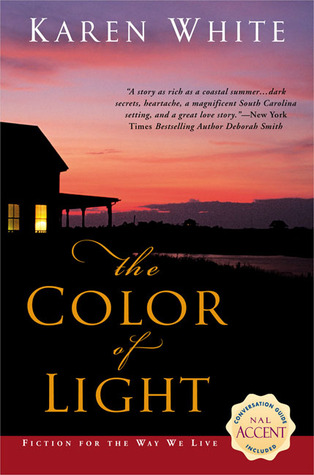
Friday Book Whimsy: The Color of Light

740854Jillian Parrish is divorced, pregnant, and understandably unhappy with her situation. She decides to move, along with her 7-year-old daughter Grace, back to her grandmother’s house on Pawley’s Island, South Carolina. The house was Jillian’s only escape from a terribly unhappy childhood in Charleston where she lived with her mother and father.

And so begins author Karen White’s novel The Color of Light, a novel I’m afraid I found to be mostly forgettable. And since White has become one of my favorite authors, I was hugely disappointed by my lack of interest in Jillian’s life.

During Jillian’s formative years, her very best friend on Pawley’s Island – Lauren – disappears and is never found. Lauren’s boyfriend Linc is initially suspected, but there is never evidence to support his involvement, and eventually the case fades away. Jillian moves away, marries a man she doesn’t love, has a daughter – Grace —  and gets pregnant again, about the same time that Grace begins having conversations with an invisible friend named (you guessed it) Lauren. This brings Jillian back to Pawley’s Island.

Perhaps White tried to stuff too many gimmicks into one novel. The Color of Light is a romance novel, a ghost story, a coming-of-age story, and a tale of an unhappy childhood. Though all of White’s novels (or at least all that I have read) involved a romance, none that I have read thus far has the romance as front-and-center as it is in this book. I am not opposed to romance in a novel – in fact, I rather enjoy a love story – I personally don’t want it to drive the story. I felt as though this novel might as well have had heaving bosoms on the cover. And let’s face it, no one is as beautiful as Linc found Jillian, both when she was pregnant and when he would blissfully watch her while nursing the new baby. Because seriously, in real life, nursing involves leaky breasts and exhausted mothers.

The Color of Light was predictable and uninteresting. Except, of course, for the setting, which was spectacular. White does such a good job of painting a picture with words when describing life on the islands in the Low Country of South Carolina.

I found myself wondering throughout the book just why a particular story line was necessary. For example, I never really understood the point of making Jillian be pregnant, unless it was simply so that Linc could help her walk, well, anywhere really since she apparently couldn’t walk by herself because of her physical state. Really? In Pearl S. Buck’s novel The Good Earth, O-Lan is working in the fields and goes inside the house, gives birth, wraps the baby up in a blanket, and goes back to work!

I will continue to enjoy Karen White’s books, because even in this one book of hers that I haven’t liked, I continued to read it because I find White’s writing to be exceptional. I just felt this wasn’t her best effort.

Here is a link to the book.

unnamed

Friday Book Whimsy: Dear Daughter

searchIt seems like every day I come across a new mystery/suspense/thriller novel that purports to be “the next Gone Girl.” Clearly, Gone Girl is the book that authors want to write (and readers want to read). Having found Gone Girl to be one of the most satisfying thrillers (in an oddly unsatisfying way) I have ever read, I must admit that I, too, am looking for the next Gone Girl.

I’m not going to go so far as to say that Dear Daughter by Elizabeth Little is on equal footing with Gillian Flynn’s amazing novel-with-the-twisted-ending, but man, the book did hold my attention, and the only thing that prevented me from throwing the book against the wall (as I did when I finished Gone Girl) was the fact that I was reading on my iPad. It wouldn’t survive the toss.

Jane Jenkins is a Kim Kardashian-type Hollywood celebrity, famous only for being the daughter of a well-known actress. Well, famous for only that up until the time that she is tried and convicted of murdering her mother, a crime she’s pretty sure she didn’t commit. I say pretty sure because there were a lot of drugs and alcohol in her life. Ten years after being imprisoned, she is released on a technicality, and sets out to find out who did, in fact, kill her mother (if it wasn’t her).

Through a bit of sleuthing (and some unbelievable coincidences), she is able to find out where her mother grew up and learns things she wouldn’t have dreamed about her mother’s life as a young woman. In the meantime, she is trying to hide from the paparazzi who are endlessly trying to find out where she went following her release. The public, you see, still think she’s guilty.

Little’s writing is sharp, perhaps a bit too sharp. Jane goes through life mouthing nothing but quips. Much of the writing is clever, but it went a bit too far. I think Little’s character development was good, and I got a great feel for who Jane is and the frustrations she felt both currently and while growing up the child of a celebrity who is famous ONLY for being the child of a celebrity.

There are a few too many coincidences to lead me to unequivocally recommend the book. Still, the story was compelling and I couldn’t stop reading, wanting to find out who actually murdered her mother. And the ending – boy oh boy. That’s all I’ll say.

Despite its flaws, I highly recommend the book (gosh, I can’t believe I’m saying this) for anyone who liked the book Gone Girl.

Here is a link to the book.

unnamed

Friday Book Whimsy: The House We Grew Up In

searchThe stars of Lisa Jewell’s highly readable novel The House We Grew Up In are about the most dysfunctional fictional family I have ever come across in a novel. And I read a LOT.

But here’s the thing: Despite their ups and downs, you can’t help but like them all. Well, almost all of them.

Clearly the most interesting thing about this novel, and the thing that at least in part makes the reader unable to turn off the light and stop reading is the hoarding. Reading about hoarding is like having a scab that you can’t leave alone. It’s unpleasant but oh-so-interesting.

And yet there is so much more to the novel, and so much more to the characters.

The Bird family lives in a pleasant cottage in the Cotswolds in England. Lorelei Bird is a lovely, charming mother of four who wants nothing more than to provide a life of joy for her children. She loves pretty, colorful things, and likes to hang on to them like we hang on to memories. Her husband and children find her to be delightful and full of love. Easter is her favorite holiday, and her annual Easter Egg Hunt provides joy each year. Until it doesn’t. Because one year something particularly terrible happens, leading the family to slowly begin to crumble.

I enjoyed the way Jewell told the story, telling the tale from each of the characters’ perspectives, going so far as to use Lorelei’s online love relationship to fill us in even more, via her letters to her online friend.

There is so much more to the novel than hoarding, but as we undoubtedly all have a secret fear that we are hoarders, it is the most compelling part of the novel.  Let me assure you, this novel will put your mind at ease. We may need to send a few things to Goodwill, but most of us can get to our kitchens.

I particularly loved the way this novel ended, despite the distressing facts we learn about some of the characters. Jewell leaves us with the idea that families who love one another can get through unbelievable stress and tribulation and love will rise above it all.

The House We Grew Up In would be a WONDERFUL novel for a reading club. Please consider it. It will be one of my favorite books of 2015.

Now, excuse me while I go clean my basement.

Here is a link to the book.

unnamed