Friday Book Whimsy: The School of Essential Ingredients

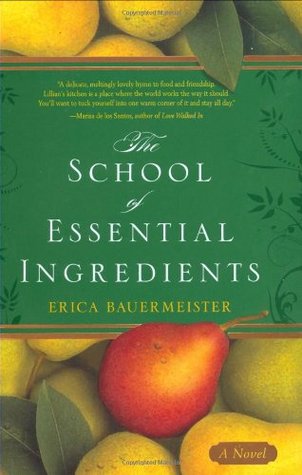
Erica Bauermeister’s novel,The School of Essential Ingredients, SHOULD have been a book that I really enjoyed. It is all about food and cooking and how the two can shape your life, and that is something I believe and about which I enjoy reading. And in fact, the story started out grabbing my attention.

Lillian is a successful chef and restaurant owner, who once a month closes her restaurant and teaches cooking classes. The classes, however, are not just about food and the preparation of meals. She believes (as do I) that good food and friends and family gathered around the table are essential ingredients for a happy life. So her classes were as much about enjoying life and friends and family as they were about preparing food.

So about the first third of the book, as Bauermeister introduced us to the characters, I was all in. I liked the variety of people and life backgrounds and reasons for taking a cooking class. But unfortunately, it didn’t take long before the characters all started seeming exactly the same. They even talked the same.

I am more than willing to suspend reality when reading a novel. But the class consisted of eight people, all of whom it seemed had lives that were coming apart at the seams. But after a class or two, and upon learning the proper way to prepare a roast turkey, their lives changed. No matter their background, suddenly they develop a suburb nose for good wine. They can differentiate between different herbs and spices in a dish simply by a single taste.  All this in a couple of classes.

Bauermeister’s writing is flowery and reminded me of drinking a wine that is just a little too sweet for the meal being eaten. Her characters ended up being boring and annoying, at least to this reader. By the end, I wanted one of them to take a taste of something and not like it. It didn’t happen.

I don’t think I will attempt another of the author’s food books. I’m not that hungry.

Here is a link to the book.

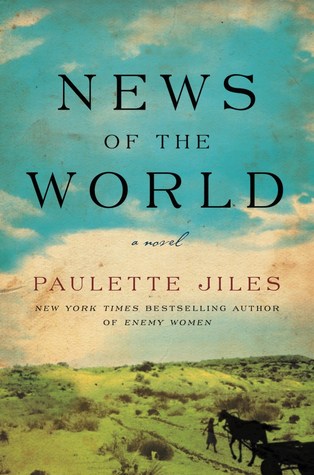
Friday Book Whimsy: News of the World

For reasons I can’t quite explain, I am drawn to novels that take place in the Old West of the 1800s. I like to imagine what it was like to live in the days before electricity, iPads, Snapchat, and nightly news.

News of the World, by Paulette Jiles, had an interesting premise. The protagonist, Captain Jefferson Kyle Kidd, served in – and was greatly impacted by – the Civil War. Now, however, he is just an elderly man who makes his money by traveling around northern Texas reading the news to people willing to give a dime or so to learn what’s happening in the world and who can’t read it for themselves. His wife is long dead, and his two daughters live far away. Still, while he’s a loner, he is satisfied with his life.

One day, he is offered a $50 in gold by the United States Army to return a 10-year-old orphan girl to her family in southern Texas. The child’s parents had been killed four years earlier by Kiowa Indians, who for unexplained reasons, took the child and raised her in the Kiowa tradition. The Army rescued her, and despite the fact that she was perfectly content in her new life, decided she needs to be returned to a distant aunt and uncle in San Antonio.

Thus begins a 400-mile journey by an elderly man and a little girl who speaks only the Kiowa language. She is terrified at the beginning, but eventually senses the man’s gentle nature and eventually comes to call him Keh-Pun, the Kiowan word for grandfather. He, in turn, tries to teach her English so that she will be able to communicate with the family she doesn’t know.

While the duo has several adventures along the way south, the book turns out to not be a story about cowboys and Indians; instead, it is a story about love and kindness. The pace is slow, sort of matching the pace of the pair as they make their journey. There are funny scenes as the little girl Johannah tries to learn the ways of the white people.

The twist comes when Captain Kidd and Johannah finally reach San Antonio, only to find a couple who is interested only in using Johannah as an indentured servant. Captain Kidd makes a decision that changes his life, and the little girl’s, forever.

As I mentioned, this is not an action novel, but a novel about relationships, trust, and love. I enjoyed the book, though I found the pace a bit slow at times. Still, it is a very short book, just this side of a novella.

Here is a link to the book.

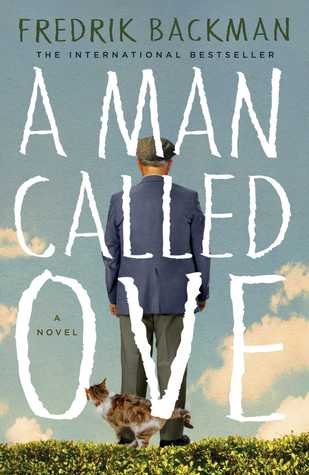
Friday Book Whimsy: A Man Called Ove

I believe I might be the last avid reader to have not read A Man Called Ove, a novel by Fredrik Backman. Part of the reason that I put off reading this book was that I so loved another novel written by Backman —  Britt-Marie Was Here — and didn’t feel that anything could compare favorably to one of my favorite novels ever written.

The comparisons between these two books are obvious. Both protagonists are seemingly crabby people who manage to find happiness despite themselves. Britt-Marie was not so much crabby as simply set in her ways.

On the other hand, Ove is as crabby as one can be, and just wants to be left alone following the death of his beloved wife, who brought out the best in him. He gets up at the same time every day. He eats the same breakfasts and does the same activities. However, he can’t get over the loss of his wife, and decides that suicide is the only answer.

Except that one suicide attempt after another keeps getting thwarted, first by his new neighbors who knock over his mailbox while trying to back up a truck; an estranged neighbor is in desperate need for his help; a scroungy cat seems to think he lives with Ove. Eventually, Ove realizes that he is important to a lot of people.

The novel is – in a word – charming. I don’t think I liked Ove quite as much as Britt-Marie, but the novel was an absolute pleasure to read. The characters are loveable and their funny ways at looking at life – and at Ove – made me laugh.

Anyone who reads this book and doesn’t feel more hopeful and happy after is simply a curmudgeon him or herself.

Treat yourself to a few days with Ove.

Here is a link to the book.

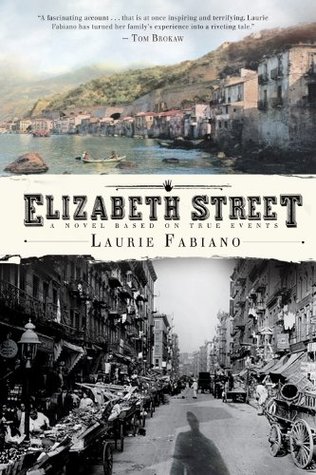
Friday Book Whimsy: Elizabeth Street

My husband and I have been lucky enough to travel fairly extensively in Italy. The bulk of our time has been in Rome, the Cinque Terre, and all over Tuscany. However, we were able to spend a bit of time in Naples and Sicily. Enough time to know that even now, in the 21st century, northern Italy and southern Italy are kind of like two different universes. Elizabeth Street, by Laurie Fabiano, reminded me that it wasn’t all that long ago when Italy wasn’t the republic that it is today, and the people in the north looked down on the people in the south and people in the south barely tolerated people in the north.

Fabiano’s novel is based on the true story of her family in Calabria – a region that is located in the “toe of the boot” that is Italy. The economy, even now, is largely dependent on fishing.  Being only a stone’s throw from the island of Sicily, the area was impacted by what would now be called the mafia.

In the beginning of Elizabeth Street, Giovanna Costa and Nunzia, the boy she has grown up loving, are married. Nunzia leaves almost immediately for New York City, where he plans to earn money in the land with streets paved with gold and return to his town of Scilla and his wife with comfortable wealth. He unfortunately dies in a construction accident caused by owner negligence. When Giovanna learns of his death, she travels to America to find out what happened and see where he is buried.

Giovanna is surprised to find that the Italian area of NYC is actually fairly segregated in the early 1800s, with Calabrians barely speaking to immigrants from Rome or Milan. She is a strong-willed and intelligent woman, and eventually learns midwifery from a woman doctor from northern Italy who lives nearby. Eventually  Giovanna marries again, this time to a widower, not for love but for more practical reasons. She marries a man who is kind and happy to have a wife to care for the children from his first marriage.

Eventually, she and her husband build a successful grocery business and things look positive. That is, until they come face-to-face with the increasing power of the so-called Black Hand, a group that was the prequel to the Mafia we know today who extorted business owners for large sums of money. The story focuses on the strength of character of Giovanna despite the trials they faced. As it is based on a true story, it was somewhat of a history lesson about life in big cities in the early 20th century.

The author told a fascinating family story with unexpected twists and turns. I loved the fact that, though a novel, it stayed true to course since it was based on her own family history.

Admittedly the story was a bit slow moving at times. But I enjoyed the descriptions of NYC in the early 20th century and, of course, all the descriptions of food and family.

Here is a link to the book.

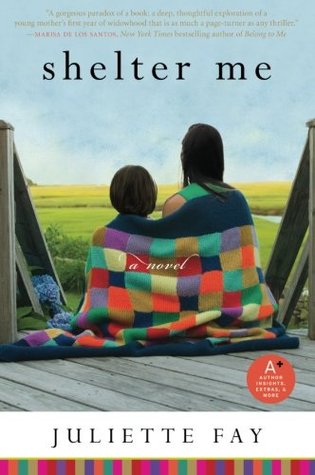
Friday Book Whimsy: Shelter Me

A few months ago, I reviewed The Tumbling Turner Sisters, author Juliette Fay’s most recent novel. That particular novel may well end up being one of my favorite reads of 2017 (though it was written in 2016). What’s more, following my post, I got a very nice email from the author thanking me for my review. Now, my mom would say that was just good manners, no?

Because I enjoyed that book so much, I decided to give another of her novels a try, and started with her debut, Shelter Me, written back in 2008. First novels can be risky business. The characters can be flat. The story is often somewhat predictable while the style can be unpredictable.

Shelter Me hooked me with the storyline, and kept me with the realistic characters and behaviors. I really liked the novel.

Young mother Janie is still reeling from the unexpected death of her much-loved husband, who was killed in a motorcycle accident. Feeling totally unprepared to be a single mother to her young kindergarten-aged son and toddler daughter, and unable to fully accept what has happened, she lives a life full of anger, confusion, and loneliness.

But suddenly a few months after her husband’s death, a stranger shows up at her door holding a piece of paper that turns out to be a contract for him to build a front porch on to their house. Her husband had made the arrangements, planning to surprise her with the beautiful addition to their home.

After getting over the surprise, Janie gives Tug permission to go ahead with her husband’s wishes.

Now, stop right there. Isn’t that a sweet premise for a book plot? There is just something so delightful as the idea of a husband surprising his wife with a front porch. I think I would have loved this novel even if that was the only thing good about it.

But it wasn’t. Janie’s sadness, often displayed as anger, is so realistic that I could practically feel her rage around me. The supporting cast – an aunt who could be annoying if she just didn’t love her niece so darn much, a neighbor who simply won’t let Janie push her away, and Tug, who is using the front porch to hide his own issues – are believable and likeable.

There was a story line relating to the parish priest who tried his best to provide Janie comfort that seemed unnecessary and simply odd, but it didn’t detract from my enjoyment of the book.

Highly recommend.

Here is a link to the book.


Friday Book Whimsy: The American Heiress

Still reeling from Downton Abbey withdrawal, I enjoyed watching PBS’s Victoria this past winter. Though based on a true story, there was enough romance and intrigue to keep me interested in a way that I wouldn’t have had it been a documentary. And as I watched the credits after the first episode, I saw that the series was based on a novel written by Daisy Goodwin. And I remembered that while I didn’t have that novel, I did own – and had owned for four or five years – another novel by that author called The American Heiress, a novel I had never gotten around to reading.

The American Heiress is the story of young Cora Cash, a New York socialite living in the late 1800s whose father was rich as triple chocolate fudge and who ran with the likes of the Vanderbilts and the Rockefellers. However, not being old money like the Astors, Cora’s mother thought the way to bring the family name up to that caliber was by having her beautiful daughter marry a British royal. A trip to England ensures that happens.

Cora’s wedding to Ivo, Duke of Warham, appears to be a perfect match. She gets a title and he gets all of that money to keep his dukedom running. And he’s so darn cute and she’s so darn pretty. But marriage to a royal when you are not only NOT nobility but not even British brings its own set of problems. And why is Ivo so quiet and withdrawn? Drama and intrigue abound. But also romance and the glorious upstairs/downstairs relationships we came to love with Downton Abbey.

The American Heiress is Goodwin’s first novel, and I found it to be captivating and interesting. The author sets the stage so clearly that I could practically smell the dust on the chandeliers. I was sorry it took me so long to finally read this book, and I will read Victoria next (even though I know FOR SURE how that one ends).

Highly recommend.

Here is a link to the book.

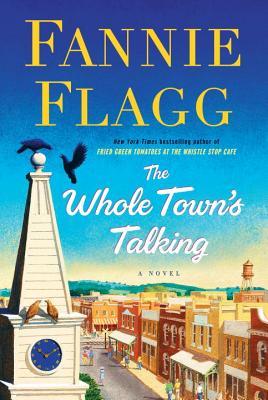
Friday Book Whimsy: The Whole Town’s Talking

Quite frankly, no one could have gotten away with this book except the author Fannie Flagg. For what other author would someone be patient enough to read a book in which most of the characters are dead and buried? Especially if it’s not a horror story?

As far as this reviewer is concerned, Fannie Flagg will never write a story as funny, poignant, and compelling as Fried Green Tomatoes at the Whistle Stop Café, but I’m glad she keeps trying. While I don’t absolutely LOVE every one of her books, I think it’s safe to say that they nearly all – or at least the ones I have read – make me smile.

That’s because the stories are all character-driven, and her characters are all lovable. Even if they’re dead.

The story begins many years ago with Lordor Nordstrom, an immigrant from Sweden homesteading in Missouri. The area in which he lives is made up entirely of Swedish immigrants. With Lordor taking the lead, the people eventually begin building the makings of a town, which they call Elmwood Springs, with Lordor serving as mayor. They build businesses, churches and even a cemetery.

The town becomes a bustling community with loving friends and neighbors, business owners, preachers, and all manner of people who make up a normal town. But things become interesting when people begin to die. Because lo, and behold, though they are buried in the cemetery, they are still able to talk and observe what’s going on in their little community.

And that’s about all that happens in the book. The story is told almost primarily through the voices of the dead. And it’s okay. Because they people of Elmwood Springs watch out for each other whether living or dead.

There are so many characters over so many years that it becomes confusing for the reader, or at least for this reader. Still, I enjoyed the book very much and it left me feeling good.

That’s about as good a compliment as I can give a novel.

Here is a link to the book.

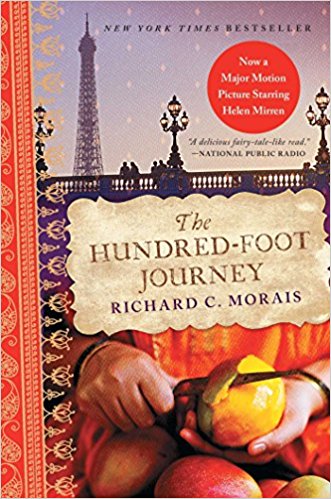
Friday Book Whimsy: The Hundred-Foot Journey

I’m a big fan of books that deal with food and cooking. Think Julie and Julia, which remains one of my favorite books (and movies, for that matter) of all time. So despite never having seen the movie, I was excited to read The Hundred-Foot Journey, a novel by Richard C. Marais.

But despite my eagerness, I have to admit that I was disappointed.

The novel actually is two stories. The first part of the book tells the story of the Haji family, Muslims who operate a restaurant in pre-World War II Bombay, India. Young Hassan watches his exuberant and frankly, almost overbearing father and gentle, food-loving mother as they take over the restaurant from his grandfather. Hassan grows up smelling the aromas of cumin and turmeric and curry, and learns to cook by watching the family. Eventually, tragedy strikes, and the family is forced to leave Bombay and move elsewhere with some unexpected money.

They first land in England, but that never quite pans out. Eventually, the Haji family’s truck breaks down in a small French village called Lumiere, and Mr. Haji decides that destiny mandates Lumiere is where they stay. He opens up an inexpensive Indian restaurant across the street from a restaurant operated by a well-renowned Michelin two-starred chef. But Madame Mallory will not have it, doing everything in her power to run the Haji family out of town. She becomes particularly enraged when she discovered that young Hussan has a perfect palate.

Once again, tragedy strikes, and Madame Mallory ends up taking the young man under her wing and teaching her everything she knows about cooking.

And then we move on to the second story, which I found, frankly, boring. Haji cooks at a variety of restaurants until he finally opens his own in Paris. He has a series of love affairs which never really amount to anything. There is only a vague tie-in with the previous part of the novel.

One of the main problems that I saw was that the food part of the novel – always my favorite – simply didn’t grab me. Generally when I’m reading a novel dealing with food, I begin yearning for the food being described. It’s true that at the beginning of the book, I craved Indian food. But in the second half of the book, the food descriptions simply didn’t connect with me. There was not much description of the cooking or the enjoyment of the meals. The author simply told us that Hassan made this or that. Boring.

Personally, I would have liked to see either an emphasis on the relationship between Madame Mallory and Hassan, or a more interesting story of Hassan’s time in Paris. The two stories simply seemed disjointed to me.

The book isn’t awful, but I couldn’t overwhelmingly recommend it either.

Here is a link to the book.

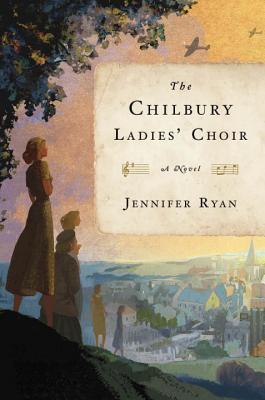
Friday Book Whimsy: The Chilbury Ladies’ Choir

Once you start reading books that take place during World War I and World War II, it’s hard to get away from it. Amazon and Goodreads both start feeding you recommendations based on what you’ve been reading and there are somewhere in the neighborhood of a million books that take place during the world wars. Most are terribly sad. The Chilbury Ladies’ Choir was a glimpse of blue sky in the dark sadness of death and hatred that war brings.

The Chilbury Ladies’ Choir is a debut novel by writer Jennifer Ryan. Though certainly not a deep and meaningful literary look at WWII as, say Sophie’s Choice, I truly enjoyed the story and the characters.

When it becomes clear that England must become involved in World War II, the small English village of Chilbury isn’t immune. One at a time, the men of the village are called to serve their country, leaving the women to carry on. Though the vicar advises that the town disband its choir because there are no male singers, the women elect instead to continue, making the controversial choice to have a women’s-only choir. Egad! But the women’s choir not only provides an outlet for singing, but more important, it provides a support group for the women of this village.

The story is told primarily through letters, which give readers a look at five particular women and how they are impacted by the war. Among the five women, particularly meaningful to me was a timid young widow whose only child is called to serve. As the weeks and months go by, she becomes stronger and more independent. She eventually becomes a driving force in keeping the town together.

The Chilbury Ladies’ Choir was a gentle reminder that war not only affects those fighting the battles, but also those left behind.

I loved the book and give it a strong recommendation.

Here is a link to the book.

Friday Book Whimsy: A Certain Age

I’ve gone through a period where it seems as though many books I’ve read take place during either World War I or World War II. I don’t need to tell you that, while they are often interesting, they are also invariably and understandably sad.

Perhaps the time period in which it takes place – the 1920s — is the thing I liked best about A Certain Age, a novel by one of my favorite authors, Beatriz Williams. That time of glamour and jazz in which people acted as though Prohibition didn’t exist, and women were freed from their corsets and gaining more and more independence. And what could be better than a novel set in the Roaring Twenties in New York City?

Wealthy Mrs. Theresa Marshall, a woman approaching middle age and bored with her marriage to a rich older man who is a serial philanderer, fights her boredom by becoming involved in an affair with a considerably younger man. She has no plans to divorce her husband, as they have a kind of understanding. But her young lover Octavian, has fallen for her and would like to get married. That is, until he meets Sophie, the daughter of a newly-wealthy man who has a mysterious past. If you are an opera fan, the plot might be familiar to you as the book is loosely based on an opera by Richard Strauss called Der Rosenkavalier.

One of my favorite things about Beatriz Williams is that many of her novels are based on different members of the wealthy Schuyler family. As such, many of the stories are loosely related. In A Certain Age, Sophie’s best friend is Julie Schuyler, who we learn is the great aunt of the main characters in three of my favorite Williams novels: Tiny Schuyler of Tiny Little Thing, Pepper Schuyler of Along the Infinite Sea, and Vivian Schuyler of The Secret Life of Violet Grant, all of whom are sisters. Not necessarily pertinent to the story, but fun nevertheless.

I will admit that it took me a bit of time to get into the novel. I felt it started slowly. Furthermore, I initially found Theresa to be offputting. She appeared to be shallow and every time she called Octavian Boyo, which she did all the time, my skin crawled. As the novel progressed, however, I began to understand the complicated Mrs. Marshall, and even grew somewhat fond of her. Sophie was a wonderful character, and I loved watching her come into herself, despite her sad past.

A Certain Age is a romantic novel wrapped in a mystery, and the ending was satisfying, if somewhat predictable. I love Beatriz Williams’ writing, and A Certain Age didn’t disappoint.

Here is a link to the book.