Friday Book Whimsy: Best Reads of 2017

My reading goal each year in terms of quantity is 100 books. I never make it, despite the fact that I think I read a LOT. In 2017, I read 91 books (and am in the process of my 92nd as we turn the pages of the calendar to 2018). That is three more than I read in 2016, and two fewer than I read in 2015. I abandoned a number of books this past year, however, which may account for fewer total books. I also had more books to which I gave a bad review than I usually have, and I don’t know exactly why that is. Generally, operating under my standard reading rule which is Life is too short – and there are too many choices – to read a bad book, I don’t finish books I dislike. This year, however, I did that on a number of occasions. Maybe I’m finally getting more mature!

I read a number of new books, but as usual, I also read a number of books published prior to 2017. So a couple of my favorite books of 2017 which are listed below were actually not published in 2017.

Having given you all of this useless background, here are the books I most enjoyed reading in 2017, with a link to my review…..

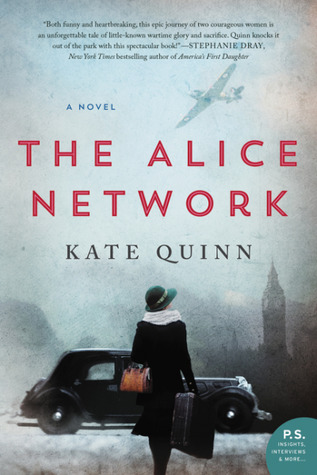
The Alice Network, by Kate Quinn
Historical fiction is my favorite genre, and stories about strong women are always of interest to me. The Alice Network is based on the true story of a network of women spies during World War I. It is 1947, and New York City socialite Charlie St. Clair begins searching for her beloved French cousin whom she doesn’t believe perished in World War II as most assume. In the course of her search, she meets Eve Gardner, who was a member of the Alice Network during WWI. The two stories intermingle, and a great novel is the result.

Before We Were Yours, by Lisa Wingate
Speaking of historical fiction, this excellent novel was based on a fact so horrifying that I almost couldn’t believe it was true. In 1939, five children who live with their parents on a riverboat in Tennessee are left alone one night when their father is forced to take their mother who is having a dangerously difficult labor into town to the hospital. While they are gone, a group of people, claiming to be government officials, enter the boat and take the children to an orphanage. Run by real-life Gloria Tann, poor children were kidnapped and then sold to rich people unable to conceive. Decades later, the daughter of a United States senator, comes across the practice and learns her family’s part in it. Great storytelling by the author.

I Found You, by Lisa Jewell
I just finished this book and haven’t yet reviewed it. Nevertheless, it is definitely one of the best books I read this past year. Jewell is the author of another book I liked – The House We Grew Up In – one of my favorite books of 2015. Single mother, somewhat bohemian in her lifestyle, Alice Lake comes across a man sitting on the beach in front of her house. She greets him only to learn that he has no memory – he doesn’t know his name, his background, or why he is sitting on the beach in this little English village. The book is a combination of three story lines that connect in a way that I dare you to predict. The story is so clever that at one point, I was so taken by surprise I thought I might have whiplash.

The Magpie Murders, by Anthony Horowitz
Speaking of clever, this murder-within-a-murder mystery is one of the more interesting books I have ever read. The charm of Hercule Poirot meets the serious police business of Harry Bosch. The author is the creator and writer of Foyle’s War, one of my favorite PBS mystery series. His writing is outstanding and I’ll bet you can’t figure out the ending.

The Tumbling Turner Sisters, by Juliette Fay
This novel is a delight from beginning to end. The father of four girls in the early 20s finds himself unable to work when he is seriously injured on the job. The family is in despair when the mother decides that the girls will learn to become acrobats and work the vaudeville circuit. Part love story, part adventure novel, part history lesson. I loved these characters and nearly everything about the story.

Happy reading in 2018!

Friday Book Whimsy: Shepherds Abiding.

My favorite Christmas book – one I read every year – is Shepherds Shepherds AbidingAbiding, a Mitford novel by Jan Karon.

The theme is familiar – what is really important about Christmas? Our favorite priest, Father Tim, brings about Christmas joy to all of those he meets throughout the season in the delightful town of Mitford. As for himself, he – who always considers himself a man of thought and not a man who works with his hands, takes on the challenge of bringing back to life a terribly neglected and badly damaged Nativity set to give to his wife for Christmas. There is a delightful “Gift of the Magi” twist to the story that I won’t give away. Shepherds Abiding gives dedicated readers a deeper look at some of the Mitford family. It also gives the reader a sense of what Christmas is like in a small town.

I read this novel every Christmas as part of my effort to remember what the holiday season is really all about.

Friday Book Whimsy: The Alice Network

People ask me all of the time how I find the books that I read. Mostly I don’t have the faintest idea. I get daily book offerings from Book Bub and Goodreads. I might click on a book on Amazon and it will give me other suggestions. Somehow or another (very likely Pinterest), I came across an informal online book club hosted by actor Reese Witherspoon, and the book being recommended was The Alice Network by Kate Quinn.

Never heard of the book. Never heard of the author. And it was another novel that dealt with (primarily) World War I and informally with World War II. Ugh. Did I want to read another World War novel? I decided I would give it a try. I’m so very glad I did.

The Alice Network is based on a true story of a French women who headed up an organization of women spies during World War I. Her pseudonym was Alice Dubois; hence, the Alice Network.

The story intertwines the lives of two separate women – Charlie St. Clair, a young  American socialite who has disgraced her family by becoming pregnant without benefit of marriage in 1947, and Eve Gardner, a young woman who suffers from stuttering who becomes involved in the Alice Network in 1915.

Charlie’s brother commited suicide shortly after returning from World War II, and Charlie handles her grief by deciding to seek out her beloved cousin who lived in France and is presumed dead. So when Charlie’s mother takes her to Europe to “take care of her little problem,” Charlie sneaks off and begins her search. In the course of events, she meets Eve Gardner and they find a connection so strong that Eve agrees to help her search for her cousin.

Throughout the course of the book, Eve tells her exceptional and often sad story to Charlie: she served as a spy during World War I, part of the Alice Network. Eve’s mangled fingers are a result of her work in the network.

Part spy story, part action novel, part feminist literature, the story and the writing are exceptional. I chuckled as often as I cried. The characters are well-drawn, and though Eve does her best to push people away, she was one of my favorite characters from all of the books I’ve read this year.

Two strong thumbs up for this exceptional novel.

Here is a link to the book.

Friday Book Whimsy: Girl in Disguise

The Pinkerton Detective Agency was founded by Allan Pinkerton in 1850, and still exists in some form today. You will see or hear about Pinkerton agents in many movies or novels of the Old West, or stories about the Civil War. The Pinkerton Agency is credited with foiling an assassination attempt on President-Elect Abraham Lincoln’s life, who then hired agents to act as his security when he was elected president. This, of course, was before the days of the Secret Service.

But when you hear or read about these agents, they are mostly men. That’s because the first woman didn’t join the agency until 1856 when Allan Pinkerton hired Kate Warne. Girl in Disguise, by Greer Macallister , is a fictional account of this real-life detective.

Kate Warne is already a widow at age 23, and desperate for a job. She answers an advertisement for a detective at the Pinkerton Detective Agency despite her lack of experience. Thinking she was applying for a clerical position, Mr. Pinkerton is surprised to learn that she is answering the detective ad. At first reluctant, Pinkerton eventually agrees to hire Kate as his first female detective.

Kate’s first job is to procure information about a gambling ring by posing as a prostitute. She successfully completes the job, much to the surprise of her fellow male agents and Mr. Pinkerton himself. Eventually she gains the trusts of at least some of her fellow agents, and is given more difficult assignments. She becomes a master of disguise and manipulation. Eventually she becomes a spy for the Union Army during the Civil War.

Based on fact, it’s true the story has an appealing protagonist. Still, I was more and more disappointed as the book went on. While Warne’s story is certainly interesting, it just seemed like nothing really ever happened. The story slogged along when it doesn’t seem like it should have. Perhaps the author stuck too strongly to fact and needed to provide a bit more excitement, given that it is historical FICTION.

I liked that I learned about a real-life person with whom I was unfamiliar, especially one who clearly broke ground for women. But I am unable to wholeheartedly recommend this book as the pace just never picked up and held my attention.

Here is a link to the book.

Friday Book Whimsy: If the Creek Don’t Rise

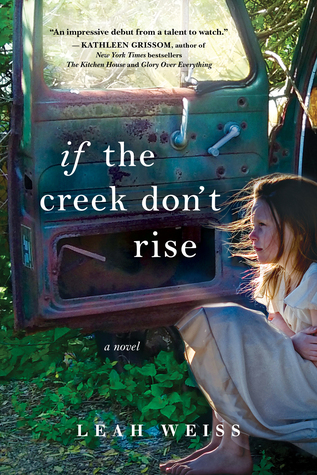
I enjoy reading debut novels. It’s like rolling the dice; they can be really, really badly written. Sometimes, however, a book will present a new voice, one that is unique and interesting. Leah Weiss, the author of If the Creek Don’t Rise, is a new author to keep an eye on. Her writing is beautiful.

Beautiful writing about a beautiful and troubling area of the United States – the Appalachian Mountains in North Carolina in the 1970s.

Young Sadie Blue is no sooner married when her new-husband Roy Tupkin begins beating the hell out of her just for the fun of it. A mere girl, pregnant with his child, she doesn’t quite know what to do or where to turn. She is surrounded by adverse poverty and by people who have never been more than a few miles from their home. Crippled by ignorance, drug and alcohol abuse, and a reliance on a belief in magic (the area’s “healer” walks around with a crow living in her hair), her family and friends are of little help.

Enter the new school marm who is not from around these-here parts, who takes Sadie under her wing and tries to help her and others. Every time she turns around, however, she is met with obstacles and mistrust and ignorance.

The story is told from 10 different viewpoints, and I frankly found it utterly confusing. The storylines are related, it’s true. It’s also true that the author does a very good job of giving each narrator a unique voice. Nevertheless, 10? Really?

Sadie knows the only way she will survive is to get rid of her husband, who is basically evil incarnate. The twists and turns of the novel are interesting, as is the seemingly realistic dialogue. The dialogue, in fact, seemed so realistic that I often had a hard time understanding what the characters were saying.

The novel has no “good guys” and “bad guys” (well, except for Roy Tupkin). Instead, each character has an interesting blend of characteristics, thereby eliminating caricatures. The ending was completely unexpected and left me squirming a bit.

If the Creek Don’t Rise is not a cheerful look at the hills of North Carolina. It is grim and depressing. I recommend it with that caveat.

Here is a link to the book.

Friday Book Whimsy: Church of the Small Things: The Million Little Pieces That Make Up a Life

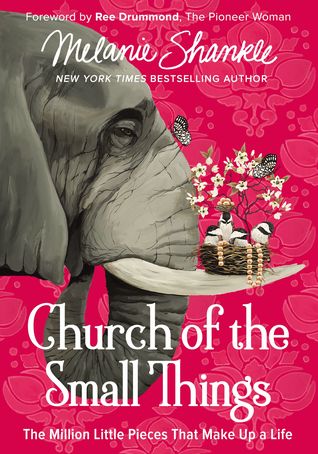
Author Melanie Shankle is a blogger, just like me. Except that she has about a billion more readers. I started following her blog a number of years ago because I liked the way she looks at life. She sees the interesting and funny and poignant and important side of every day.

I think it’s pretty common to measure our success in life by the big things. The significant events. The important job with the high salary. The child who gets into Stanford. The big kitchen with white cabinets and marble countertops and a window looking out onto your pool. Let’s face it, however. Most of us won’t have kids attending Stanford or Harvard or Smith College. We’re more liable to have a modest home with three bedrooms and a mortgage. Does that make us less successful?

Shankle doesn’t seem to think so, and she shares her thoughts on what’s important in life in her latest book Church of Small Things: The Million Little Pieces That Make Up a Life. She tells her readers what makes her laugh and be proud and shed tears through a series of vignettes about her everyday life. And her stories are so, so funny. It’s not that extraordinarily funny things happen to her; instead, it’s how she looks at life and how she sees the funny sides of everything.

I can’t tell you how many of her stories hit such a note with me that I found myself saying out loud: Yes, I feel that way too. Her story, for example, about buying a white sofa that she simply felt she  couldn’t live without only to discover that (as her husband said) “We aren’t white sofa people,” made me think about all of the things I have bought in my life that I felt were important at the time that now sit on a shelf gathering dust. In a simply hilarious story, she tells about how hard she worked to keep that sofa clean before she finally gave up and thereby made her life a lot easier.

I laughed so hard at some of her stories, and shed tears at others, particularly when she talked about the loss of a dear friend from breast cancer. It’s a good writer who can create such emotion using just her words.

Her faith in God helps her deal with the good and the bad. Shankle talks about her spiritual life and how prayer and faith have helped her through difficult times.

Church of the Small Things is a book I will look at again and again.

Here is a link to the book.

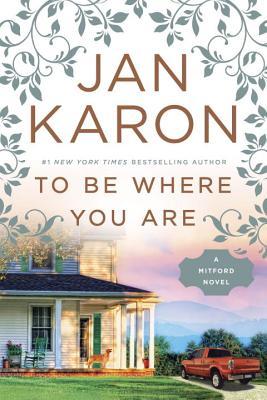
Friday Book Whimsy: To Be Where You Are

I read Jan Karon’s novel To Be Where You Are earlier this fall shortly after it was released, and it happened to be a particularly difficult time in my life. The latest in her Mitford series featuring our favorite Episcopalian priest Father Tim was an ointment for my heart soul, just as I knew it would be.

The entire series – now a total of 14 books – takes place in the fictional town of Mitford, North Carolina, a small village in the Blue Ridge Mountains near Asheville. While Father Tim and his wife Cynthia are the stars of the show, the surrounding players – his son Dooley and various beloved family and friends – are really what make these stories so lovely. Karon manages to make the townspeople lovable and quirky, but not caricatures of small-town hillbillies.

In her latest novel, Dooley and Lace, now married, are preparing for formal adoption of their foster son Jack, while trying to get Dooley’s vet practice going. Lace has her own distractions, as she has been commissioned to do a painting for a well-known Hollywood actress. All of this takes place as Father Tim struggles to help out several friends in unexpected ways. While a town like Mitford likely doesn’t exist anywhere, Karon’s books always have a realistic way about them. In To Be Where You Are, faithful readers say goodbye to a beloved friend, as we have had to do in the past, but hello to others.

The story is punctuated by the characters’ strong faith in God and belief that they are all part of a bigger plan. I took the prayers uttered by the characters to my heart and prayed them along with them. Much highlighting. Very much highlighting.

To Be Where You Are reminded this reader that at the end of the day, it isn’t the amount of money you earn or the fancy house in which you live, but instead it’s the number of people you can call friends and the blessings that are in you life.

Karon is in her 80s now, and I don’t know how many more Mitford stories she has in her. I hope a few more. While To Be Where You Are left us with a perfect segue to the next book, it also ends with Father Tim and Cynthia driving off in an RV for an adventure. A perfect way to end a series.

Fingers crossed it’s the former. I loved this book.

Here is a link to the book.

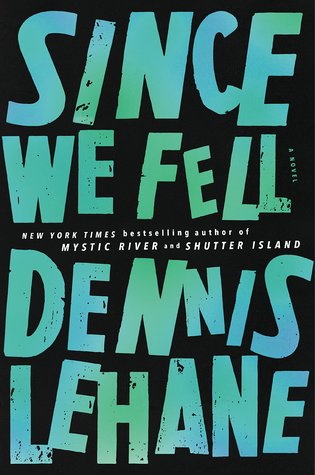
Friday Book Whimsy: Since We Fell

Author Dennis Lehane is a good story teller, particularly when it comes to character development. A number of his books have been made into movies – Shutter Island and Mystic River, both dark and interesting films. Since We Fell will likely be no exception. It seems to have been written to be made into a movie.

Like many of Lehane’s central characters, Since We Fell’s protagonist Rachel Childs stayed with me long after I finished the book. She wasn’t exactly likeable, but she felt real to me and though I couldn’t quite relate to the dark side of her personality, the fact that she was multifaceted instead of one-dimensional was a plus.

Childs’ never knew her father, and her mother wouldn’t tell her who it was. Her mother had long ago written a book about parenting that apparently earned her enough money to live on the rest of her life. And yet, she was probably one of the worst parents I’ve ever come across in a novel. She was selfish and manipulative and gave Rachel an entirely unstable childhood.

The book is written almost like two separate novels. Rachel (who is a television journalist) spends the first half of the book trying to find her father. She is determined to find the man who her mother refuses to identify despite Rachel’s never-ending pleas.

Rachel teeters on the edge of unstability, and after visiting Haiti in her role as a journalist, and witnessing poverty and violence like she’s never seen, she has an on-air breakdown, is subsequently fired, and spends the next few years not leaving her home. Her husband, himself a self-serving TV journalist, divorces her.

She eventually reconnects with a man who has made brief appearances throughout the book, and responds to his kindness. They marry.

Then the book gets complicated and Part 2 begins. I know. I know. Part 1 seems complicated enough!

I won’t go into a lot of detail about the second part of the book, but it becomes a thriller that deals with trust and greed and who one can love. Part 2 finally clarifies why the first line of the book is “On a Tuesday in May, in her thirty-fifth year, Rachel shot her husband dead.”

In looking at reviews, opinions range from I couldn’t put this book down to this convoluted story made for one of the worst books I’ve ever read. I fall somewhere in between, but lean to the can’t-put-the-book-down side.

It’s true that much of the story is convoluted and demands that the reader suspend reality, but I just kept coming back to the characters. They were just so danged interesting.

A review of this book is difficult to write without giving away the surprises, and the twists and turns are critical. So you’ll just have to read Since We Fell yourself and see what you think.

Here is a link to the book.

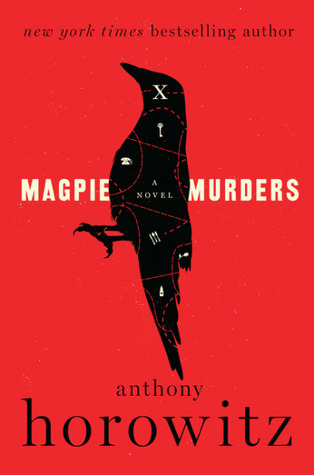
Friday Book Whimsy: Magpie Murders

Magpie Murders, by author Anthony Horowitz, is a refreshing break from many mystery novels with predictable plots and authors that try just a bit too hard to give the reader a surprise ending. Horowitz is the creator and writer of one of my favorite British television crime dramas Foyle’s War, so I was very excited to see what he had up his sleeve with the unusual format of this novel.

Magpie Murders actually gives the readers two separate mysteries to ponder – a mystery within a mystery, so to speak.

Editor Susan Ryeland is given a copy of the manuscript of author Alan Conway’s latest novel featuring his famed detective Atticus Pund. Pund is very much like Agatha Christie’s famed detective Hercule Poirot, spending his time solving mysteries in little English villages, providing his readers with hints and red herrings galore. Since Ryeland has been Conway’s editor from the get-go, she is used to his formula; however, the more she reads, the more she thinks Conway is giving the reader a mystery within a mystery.

She continues to read, but just as Pund is getting ready to gather the suspects together to identify the killer, the story stops. Whaaaaat? The last chapter is missing. Why did Alan Conway not finish the book, but turn it in to his editor anyway shortly before he commits suicide?

Despite being ordered by her boss to leave it well enough alone, Ryeland begins trying to figure out why Conway would end the story in this manner. As you follow along with Ryeland, can you figure out what’s going on?

What I liked best about this book is that in the first chapter, Ryeland sits down with a cup of tea and hours of time and begins to read the manuscript. And then the book is presented to the readers of Magpie Murders just as Ryeland is reading it. And the Pund novel is a fun romp, very reminiscent of Agatha Christie. Manor houses, murders, mysterious guests. If that had been the entire book, I would still be giving it a good review.

But it isn’t. Because suddenly, the book ends, and the second mystery begins. It was so much fun (if you can call murder and suicide fun).

This really is a must-read for lovers of good mysteries with challenging endings, and definitely a must-read for Agatha Christie fans. As for me, I’m on the lookout for other books by this author.

Here is a link to the book.

Friday Book Whimsy: Cocoa Beach

What comes first, the chicken or the egg? That was the question I asked myself as I read Cocoa Beach, the latest novel from Beatriz Williams.

As with many of the author’s novels, the story is connected in some way to characters in another of her books. It took me a bit to realize that the main character of Cocoa Beach was the sister of one of the main characters in A Certain Age, a novel that I read and liked very much, despite a slow start. As I read this latest book, I found myself wondering if the author wrote these two books in the wrong order, as Cocoa Beach is somewhat of a prequel.

The novel tells the back story of Virginia Fortescue, the sister of Sophie Fortescue of A Certain Age fame. Cocoa Beach is a mystery novel from the get-go. In fact, the very first chapter is an incriminating letter from the man who will become Virginia’s husband, setting the stage for what might have been a really interesting story.

Except that it wasn’t. Instead, it was a confusing back-and-forth story about Virginia during World War I where she works as a driver and first meets Simon and then about Virginia a few years later in the Roaring 20s when she is trying to figure out who is trying to kill her, and why. Is it her husband? Is it his brother? Most of the time I just found myself trying to figure out what year it was and who was doing what. I found it to be most confusing.

The location was new and different for the author. While many of her novels take place in New York City, Cocoa Beach took place in, well, Cocoa Beach, Florida, as well as Miami, Florida.

As Virginia tries to figure out what is going on, she keeps hearing about what is happening back home in New York with her sister Sophie and her father, accused of killing her mother (part of the plot of A Certain Age). It added to the muddle and confusion of the novel.

I must say that the author kept us wondering until the very end just who were the good guys and who were the bad guys. But Williams pulled a trick that I simply loathe: at the very end of the novel, something happens that ensures that there will be a sequel. It frankly was so badly written that I sat and stared at the book for some time, wondering if I had missed something.

I simply didn’t care for this book. I found it entirely too confusing and silly. That’s a hard pill for me to swallow from an author whom I like so much.

Thumbs down on this one.

Here is a link to the book.