
 I don’t think it’s unfair to say that the days when we all eagerly garnered our news from the daily newspaper are over. Bill and I don’t even get a daily newspaper any longer. When our neighbor asks us to retrieve hers while she’s away on vacation, we are always surprised at how flimsy it is and how little news is actually provided. The reality is that by time we look at the newspaper, most of the news is old and boring as compared to what we’ve read on the internet.
But as a journalism major and a former newspaper reporter, I loved to read newspapers. I also love to learn about the history of news gathering throughout the years. One journalism story not to be missed is the history of the tabloid newspaper wars in New York City in the late 1800s and early 1900s.
I think I read somewhere that at its height, there were something like 19 newspapers being published in New York City at one time in the late 1800s. The names Joseph Pulitzer and William Randolph Hearst are familiar to us all. There was a lot of pressure to gain readership, and news gathering back in those days was much different than now, and not necessarily in a good way.
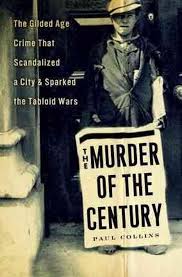
Murder of the Century: The Gilded Age Crime That Scandalized a City & Sparked the Tabloid Wars, by historian author Paul Collins provides a perfect picture of how newspapers “reported” the stories back in those days. Truth and facts were optional. Anything to gain attention and readership was permitted.
Collins’ book is an interesting account of a real murder that took place in 1897 in New York City. The headless torso of a man was found floating in the East River by some young boys, who promptly took it to the police. The police dismissed the body’s importance noting that it was probably tossed into the river by medical college personnel following its use by medical students. Really????? And yuck!!!!!
But the newspapers – primarily Pulitzer’s New York World and Hearst’s New York Journal – sniffing the makings of a great story – glommed onto the murder mystery and began solving it on their own via daily news stories. Accuracy was not necessary. Eventually the police began taking it seriously.
The result was an investigation, trial, sentence, and execution that may or may not have been justified. The head, you see, was never found. As a result, it was never 100 percent certain who the body was. Trivialities.
Collins’ story reads very much like a novel. He paints a vivid picture of what life was like in New York City at the end of the 19th Century. His story captures the role of the daily newspapers perfectly, in much the same way as did the book Eighty Days: Nellie Bly and Elizabeth Bisland’s History Making Race Around the World, by Matthew Goodman.
As a journalist, I cringed when I read the treatment of the murder story by the newspapers. But as a writer, I couldn’t help but think just how much fun it would have been to chase a story like that with really no rules to follow.
I think this book would make for good discussion for a book group if it is looking for a very readable nonfiction book.
Buy the book from Amazon here.
Buy the book from Barnes and Noble here.
Buy the book from Tattered Cover here.
 Nana's Whimsies